
There’s a two-block stretch of Mulberry Street in Lower Manhattan where Italian flags still hang from fire escapes and the smell of cannoli drifts out of century-old bakeries. But what you’re standing in today is a shadow — a proud, stubborn shadow — of one of the most extraordinary immigrant communities ever built on American soil.
When Little Italy Was Really Italy
At its peak in the early twentieth century, Little Italy stretched from Canal Street to Houston Street, covering more than forty city blocks. Over 10,000 Italian immigrants lived packed into the tenements there, and on summer evenings the streets were so dense with people you could barely move.
They had come from Sicily, Calabria, Naples, and Campania, arriving at Ellis Island with almost nothing. They rebuilt their villages in the middle of Manhattan — their own churches, their own newspapers, their own social clubs, and their own rules.
It wasn’t just a neighborhood. It was a world within a world, where you could live an entire life without speaking a word of English.
The Migration Nobody Talks About
After World War II, something shifted. Italian-Americans started doing well. Their children went to college. They got better jobs. They could afford to move — to Queens, to Long Island, to New Jersey, to Westchester.
It was the American dream playing out exactly as intended. Families who had lived ten to a room were buying houses with yards. But success has its price. The neighborhood they left behind began to empty out.
By the 1970s, Little Italy had lost most of its residents. The apartments were snapped up by artists, then young professionals, then tech workers paying rents that would have seemed surreal to the men who once sat outside those same buildings playing cards.
How Chinatown Swallowed the Map
At the same time, something else was happening just a few blocks south. Chinatown, confined for decades to a small area around Mott and Canal Streets, began to expand rapidly after the 1965 Immigration Act opened the door to a new wave of Chinese immigrants.
Block by block, what had been Little Italy became Chinatown. Italian bakeries and social clubs gave way to dim sum restaurants and herbal medicine shops. Today, if you walk north from Canal Street, the transition is almost imperceptible — one block is Cantonese, the next holds a few Italian restaurants with flags in the window, the next is Cantonese again.
Little Italy as a living neighborhood essentially no longer exists. What remains is a proud, stubborn stretch of roughly four blocks — kept alive by tourists and a handful of family businesses that have simply refused to leave. New York’s Chinese communities have continued to expand far beyond the original Chinatown borders, reshaping the map of Lower Manhattan in ways the early Italian immigrants couldn’t have imagined.
Enjoying this? Join New York lovers getting stories like this every week. Subscribe free →
The Festival That Holds It Together
Every September, for eleven days, the neighborhood does something remarkable.
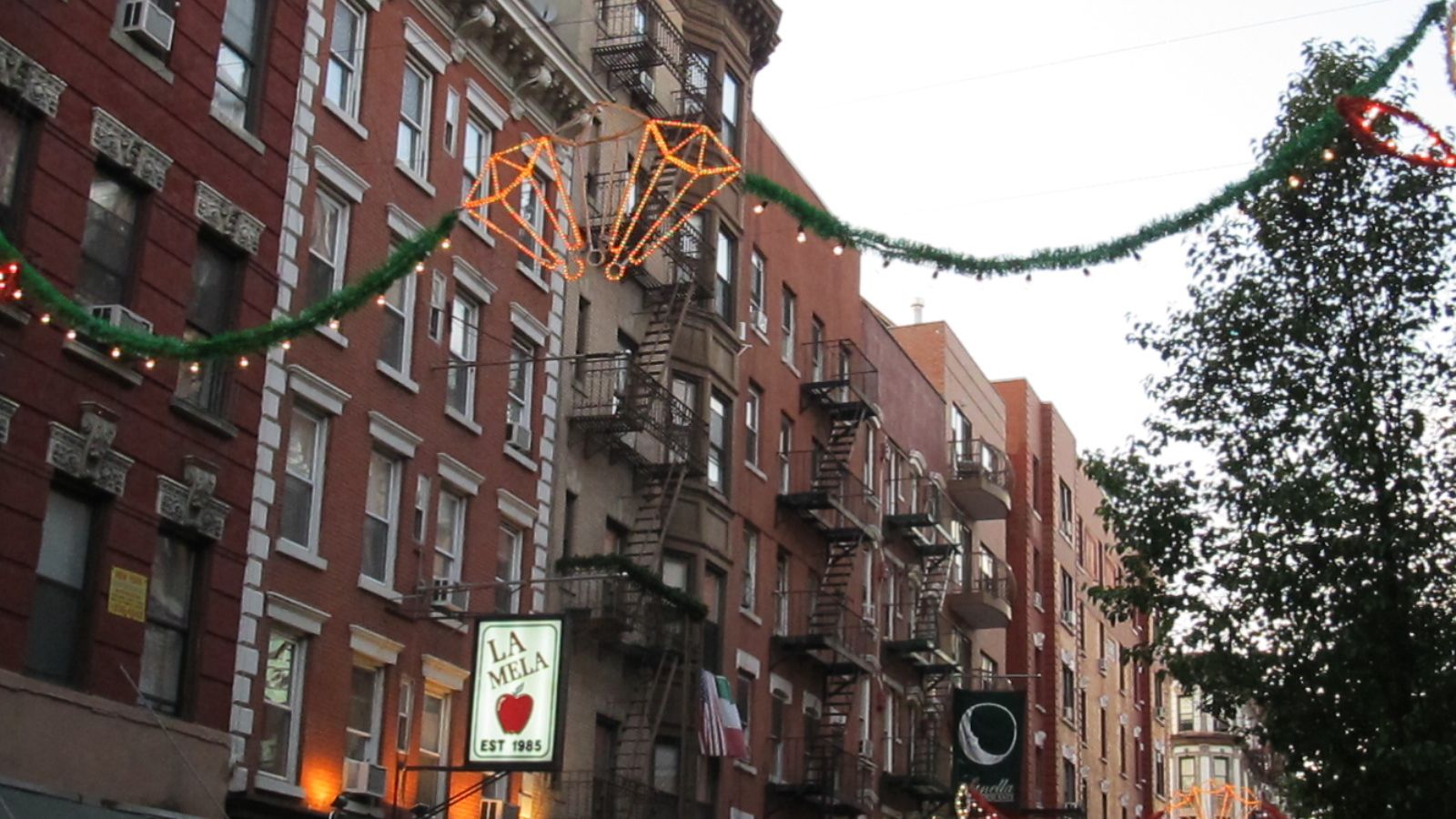
The Feast of San Gennaro — honoring the patron saint of Naples — takes over Mulberry Street. Sausage carts, zeppole vendors, and red-and-green lights fill the block from Canal to Spring. Hundreds of thousands of people come from across the city and beyond.
For those eleven days, Little Italy feels less like a memory and more like a living thing. Old-timers who moved to Long Island decades ago make the trip back. Their grandchildren, who have never lived in the neighborhood, walk the same streets their great-grandparents walked. The Feast of San Gennaro is, in its own way, the single thread that keeps Little Italy from disappearing entirely.
The Families That Didn’t Leave
A handful of businesses have been here for generations. Ferrara Bakery opened in 1892. Di Palo’s Fine Foods, run by the same family since 1925, still sells fresh mozzarella and imported Italian goods behind a counter that looks like it hasn’t changed in fifty years.
These places exist not just as businesses but as artifacts — living proof that something was here. The families that run them know their neighborhood is mostly gone. They run them anyway.
Ask Lou Di Palo about the old neighborhood and he’ll talk for an hour. Not with bitterness — with love. That distinction matters.
What Little Italy Became
The story of Little Italy is also the story of New York. The city doesn’t preserve its past — it builds on top of it, absorbs it, transforms it. The Italians expanded and changed the map in their time, just as the communities that followed them changed it in theirs.
What’s left on those few blocks of Mulberry Street isn’t a museum. The people who work there don’t want your pity, and they’re not performing nostalgia. They’re running bakeries and restaurants because they love what they do — and because some things are worth keeping even when the rest of the world has moved on.
Walk it on a weekday evening, when the tourists have gone home and the shutters are going up on the old social clubs. Get a cannoli from Ferrara. Linger a little. Four blocks can hold more history than you’d think.
You Might Also Enjoy
- The September Street Festival That Refuses to Let Little Italy Disappear
- The Queens Neighborhood That Quietly Became More Chinese Than Chinatown
- The Brooklyn Neighborhood That Went From Ghost Town to Global Symbol in 20 Years
Plan Your New York Trip
Ready to explore Lower Manhattan’s layered history for yourself? Our complete New York travel guide covers the best neighborhoods, hidden gems, and practical tips for making the most of the city.
Join New York Lovers
Every weekday morning, get New York’s hidden gems, neighbourhood stories, food origins, and city secrets — straight to your inbox.
Subscribe free — enter your email:
Love more? Join 65,000 Ireland lovers → · Join 43,000 Scotland lovers →
Free forever · Unsubscribe anytime
