
George Gershwin was born in a tenement flat in Brooklyn. His father, Morris, had arrived from Russia with almost nothing. Irving Berlin grew up on Cherry Street on the Lower East Side, singing for pennies after his own father died and left the family without income. Aaron Copland’s parents ran a general store on Washington Avenue in Brooklyn, and none of their neighbours would have guessed their American-born son would one day define the sound of America itself.
These men did not inherit their genius from concert halls or conservatories. They inherited it from streets that smelled of fish and garlic, from tenements with shared toilets, from synagogues where the cantor’s voice rose above the noise of the city, and from a hunger — quite literally — to make something of themselves in a country that was still deciding whether it wanted them.
If you love New York’s hidden stories, you’ll love our free weekly newsletter. Subscribe to Love New York →
Irving Berlin: From Cherry Street to “White Christmas”
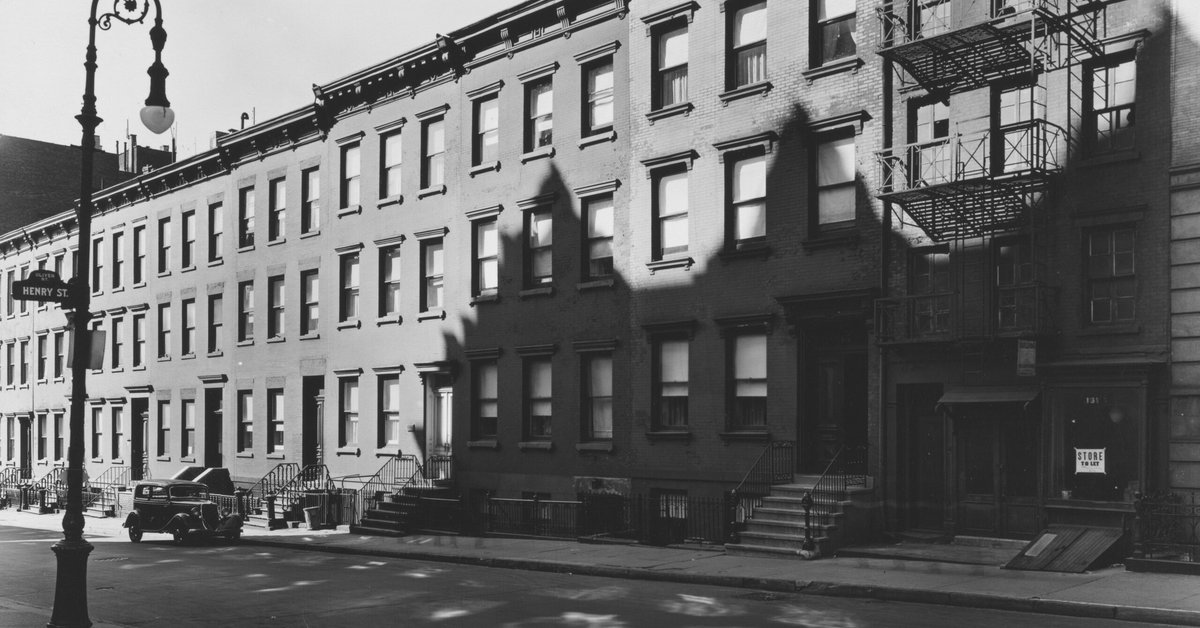
Israel Beilin arrived at Ellis Island around 1893. He was five years old. His family had fled the pogroms in Tyumen, Siberia, and they settled on Cherry Street on the Lower East Side — one of the most crowded blocks in one of the most crowded neighbourhoods on earth.
Cherry Street no longer exists in quite the same form. It sits south of the Brooklyn Bridge, in a stretch of lower Manhattan that was transformed by urban renewal in the mid-20th century. But in the 1890s and early 1900s, it was packed with recently arrived Russian and Eastern European Jewish families, each one navigating a new language, a new culture, and a new set of rules.
When Israel Beilin’s father, Moses — a synagogue cantor — died in 1901, the family lost its primary income. Israel was thirteen. He left home and began sleeping in flophouses near Bowery, earning money by singing popular songs in saloons and on street corners. He changed his name to Irving Berlin because it sounded less Russian, less Jewish, more like someone who belonged here.
By 1911, he wrote “Alexander’s Ragtime Band.” It was not the first ragtime song ever published, but it was the one that made the whole country stop and listen. Over the next six decades, he would write more than fifteen hundred songs. “White Christmas.” “God Bless America.” “Puttin’ On the Ritz.” “Anything You Can Do.” “There’s No Business Like Show Business.”
None of those songs exist without Cherry Street. Without the cantor’s son who learned to carry a melody before he learned to read English. Without the saloons of the Lower East Side where a teenage boy discovered that music could buy you a meal.
Berlin never took a music lesson. He played piano in one key — F-sharp major, using only the black keys. He had a special piano built with a lever that could transpose his compositions into whatever key he needed. When a musician once asked him why he never learned the other keys, Berlin said: “What for? I’ve done all right with one.”
George Gershwin: Born in Brooklyn, Made on Tin Pan Alley
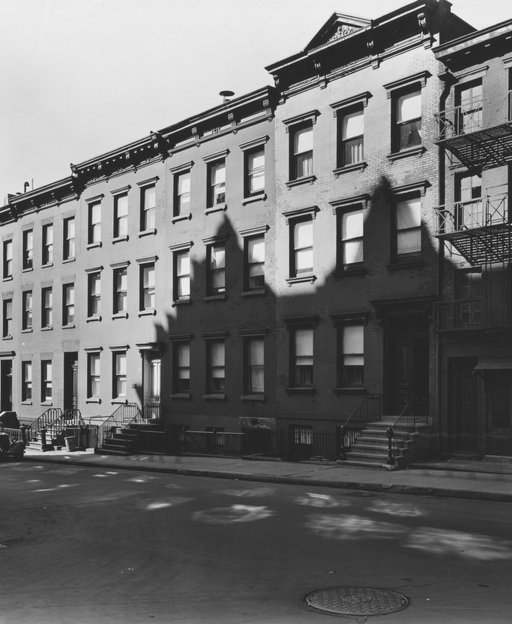
George Gershwin was born Jacob Gershowitz on 26th September 1898, at 242 Snediker Avenue in Brooklyn — a working-class neighbourhood in what is now East New York. His parents, Rose and Morris, had arrived from St Petersburg in Russia. Morris Gershowitz changed the family name to Gershvin, then to Gershwin, depending on which immigration officer was filling out the paperwork on which particular day.
The Gershwins were not a musical family, at least not intentionally. They moved frequently around Brooklyn and the Lower East Side — more than twenty apartments before George turned ten — as Morris tried his hand at bakeries, restaurants, a Russian bath house, and a poolroom near Coney Island. Stability was not a feature of their early years in America.
When George was ten, the family bought a secondhand upright piano for his older brother Ira. Within hours, George had sat down at the instrument and begun picking out a melody he had heard on a player piano at a penny arcade. He was, by any reasonable measure, a prodigy — but nobody knew it yet.
At fifteen, he dropped out of school and got a job on Tin Pan Alley — the stretch of West 28th Street in Manhattan where music publishers clustered in the 1910s. He earned eleven dollars a week playing demonstration songs on the piano for customers who might want to buy the sheet music. He was the youngest song plugger in the building.
By 1924, he had written Rhapsody in Blue. He was twenty-five. It premiered at Aeolian Hall on West 43rd Street with Paul Whiteman’s orchestra, and the audience — packed with journalists, composers, and sceptics — gave it a standing ovation. Classical music and jazz had never sat in the same room together quite like that before.
Want more stories like this? Our weekly newsletter goes deeper into New York’s heritage every week. It’s free. Subscribe here →
What Gershwin understood, instinctively, was that Rhapsody in Blue was the sound of New York — not the New York of concert halls and debutante balls, but the New York of his own childhood. The noise and the pace and the dissonance of it. The way the city could be joyful and lonely at the same time. He had absorbed all of that on the streets of Brooklyn and the Lower East Side, and he put it into the music.
He died in 1937 from a brain tumour. He was thirty-eight. Ira Gershwin, his lyricist brother and lifelong collaborator, lived until 1983 — long enough to see his brother’s music become part of the permanent soundtrack of American life.
Aaron Copland: The Brooklyn Boy Who Invented America’s Sound
Aaron Copland was born on 14th November 1900, at 628 Washington Avenue in Brooklyn’s Crown Heights neighbourhood. His parents, Harris and Sarah, had emigrated from the Russian Empire — from a small town in what is now Lithuania. They ran a general store called H.M. Copland’s, with the flat above the shop serving as the family home.
Copland was the youngest of five children and the first born in America. Like Gershwin, he was not born into a musical household — his parents valued hard work and education, but not particularly the arts. He taught himself to read music from a book. He took piano lessons from his older sister, who had taken lessons from a teacher down the street.
What separated Copland from many of his peers was his determination to sound American. He studied in Paris under the legendary teacher Nadia Boulanger. He came back to New York convinced that American music should not try to sound European. It should sound like the prairies, like frontier towns, like cowboys and Appalachian settlers — none of which he had ever actually seen, but all of which he had heard about while growing up above a general store in Brooklyn.
Appalachian Spring. Fanfare for the Common Man. Rodeo. Billy the Kid. These are works that define the American sonic landscape, and every single one of them came from the imagination of a Lithuanian-Jewish boy from Crown Heights who had never spent a night outside a city.
What Connected Them — and What They Were Reaching For
Berlin, Gershwin, and Copland never set out to become legends. They set out to become American. That was the project — for them and for thousands of other families who arrived through Ellis Island and made their way to the tenements of the Lower East Side and Brooklyn. Becoming American meant speaking English, finding work, and, if you were lucky, finding a way to contribute something to the place that had taken you in.
Music was the fastest route to belonging. You did not need a degree. You did not need connections. You needed a good ear and the willingness to work, and New York in the early twentieth century offered those with both a route upward that almost no other city in the world could match.
The Lower East Side in the 1890s and 1900s was not a romantic place. It was overcrowded, often dangerous, and frequently desperate. Rents on Orchard Street were four or five dollars a month for a flat with no running water and a shared toilet in the hallway. Families of eight or ten lived in three-room apartments. Children worked. Women took in piecework. Men did whatever they could.
But the same streets that produced Irving Berlin also produced a culture of extraordinary richness. There were more than a dozen Yiddish-language newspapers. There were theatres on Second Avenue where actors like Jacob Adler performed in Yiddish to packed houses. There were lending libraries and debating societies and labour unions and synagogues of every denomination. The Lower East Side was, in its chaotic, crowded way, one of the most intellectually alive places in the world — and the children who grew up there absorbed all of it.
This is worth keeping in mind when you visit the Lower East Side today. The tenements are still there. The Tenement Museum on Orchard Street gives you access to apartments that have been preserved exactly as they were left by families who moved out in the early twentieth century. You can walk Orchard Street, Delancey Street, and Hester Street and understand, in a way that no textbook can give you, what it meant to live here. What it cost. What it produced.
Where to Trace These Roots Today
Several of the specific addresses associated with Berlin, Gershwin, and Copland are still standing or can be visited in their original neighbourhoods.
The Tenement Museum, 103 Orchard Street, Lower East Side — This is the single best starting point for understanding the world Berlin and Gershwin grew up in. The museum preserves apartments on Orchard Street that were home to immigrant families between the 1860s and 1980s. Guided tours take you through apartments belonging to specific families — Irish, Jewish, Italian, and later Puerto Rican tenants. Booking in advance is essential.
Cherry Street, Lower Manhattan — The stretch of Cherry Street where the Berlin family lived no longer exists in its original form; most of it was cleared for the Alfred E. Smith public housing development in the 1940s. But the street itself still runs through lower Manhattan, and it is worth walking it for the sense of place. The neighbourhood around it — just south of the Brooklyn Bridge — still carries echoes of the immigrant city it once was.
Snediker Avenue, East New York, Brooklyn — This is where George Gershwin was born. The street still exists in the East New York neighbourhood, though the original tenement building at 242 Snediker Avenue was demolished long ago. The area today is a working-class residential neighbourhood in eastern Brooklyn, and it gives you a real sense of how far removed Gershwin’s origins were from the Carnegie Hall stage he would eventually conquer.
Washington Avenue, Crown Heights, Brooklyn — The neighbourhood where Copland grew up is today one of Brooklyn’s most culturally varied areas. The stretch of Washington Avenue between Eastern Parkway and Atlantic Avenue has been transformed many times over since 1900, but the street and the neighbourhood remain vital and alive. The Brooklyn Museum, which Copland surely visited as a boy, sits at the northern end of Eastern Parkway.
West 28th Street (Tin Pan Alley), Manhattan — The stretch of 28th Street between Fifth and Sixth Avenues is where the New York music publishing industry concentrated in the early twentieth century. This is where the teenage George Gershwin worked as a song plugger. A small historical marker acknowledges the block’s history. Midtown Manhattan has changed enormously since those years, but the grid remains the same.
YIVO Institute for Jewish Research, 15 West 16th Street, Manhattan — YIVO holds the most extensive collection of documents, photographs, and records relating to Eastern European Jewish life in America. If your own family came through the Lower East Side in the early twentieth century, this is where you begin your search. The staff are experienced in helping people trace immigrant ancestry through New York and the old country alike. For more on tracing your NYC roots, see our guide to New York City ancestry research.
The Legacy on the Streets
There is a line that runs, quite directly, from the tenements of Cherry Street and Snediker Avenue to the stages of Carnegie Hall and the radio broadcasts that defined American culture in the twentieth century. It is not a line of privilege or advantage. It is a line of hunger, of determination, and of an extraordinary concentration of talent that the immigrant Lower East Side somehow managed to produce in a single generation.
Irving Berlin died in 1989 at the age of 101. He outlived virtually everyone who had known him as a young man on the Lower East Side. In his later years, he said that America had given his family everything, and that everything he had done in his life was a way of saying thank you. That included “God Bless America,” which he wrote in 1918 and then put in a drawer for twenty years before releasing it in 1938, when the world was beginning to look very dangerous again.
George Gershwin’s music is still performed every week in New York. Rhapsody in Blue is played regularly at venues across the city. Porgy and Bess — his 1935 opera, dismissed by some critics as too jazz-inflected to be serious — is now considered one of the great American operas. His Harlem-influenced compositions helped bring jazz vocabulary into the concert hall and gave American music a hybrid energy that European composers had never managed to create.
Aaron Copland’s Fanfare for the Common Man is played at presidential inaugurations. It sounds like wide-open spaces, like the American interior, like something ancient and optimistic at the same time. It was written by a man who spent his entire early life in a flat above a general store on Washington Avenue in Brooklyn, looking out at a street full of neighbours who had all come from somewhere else.
Frequently Asked Questions
Where was George Gershwin born in New York?
George Gershwin was born on 26th September 1898, at 242 Snediker Avenue in the East New York neighbourhood of Brooklyn. His parents were Russian-Jewish immigrants who had arrived in America a few years earlier. The original building no longer stands, but the street still exists in eastern Brooklyn.
Where did Irving Berlin grow up in New York City?
Irving Berlin (born Israel Beilin) grew up on Cherry Street on the Lower East Side of Manhattan after his family arrived from Russia around 1893. After his father died, he left home as a teenager and supported himself by singing in saloons and on street corners in the Lower East Side and Bowery area. Most of the original Cherry Street tenements were demolished during urban renewal in the mid-twentieth century.
Can you visit the Tenement Museum near where these composers grew up?
Yes. The Tenement Museum at 103 Orchard Street on the Lower East Side preserves apartments from the same era and neighbourhood where Irving Berlin and the Gershwin family lived. Guided tours are available and must be booked in advance. The museum offers one of the most direct experiences available anywhere of what immigrant tenement life actually looked and felt like in the early twentieth century.
Where was Aaron Copland born?
Aaron Copland was born on 14th November 1900, at 628 Washington Avenue in the Crown Heights neighbourhood of Brooklyn. His parents were Lithuanian-Jewish immigrants who ran a general store on the same block. Copland was the first of the five Copland children to be born in America.
What is the best way to explore Jewish immigrant heritage in New York City today?
The best starting point is the Tenement Museum on Orchard Street in the Lower East Side, which offers guided tours through preserved immigrant apartments. For genealogical research, the YIVO Institute for Jewish Research at 15 West 16th Street in Manhattan holds extensive records relating to Eastern European Jewish families in America. Walking Orchard Street, Delancey Street, and Hester Street gives you a strong sense of the neighbourhood’s historic character.
Ready to explore the New York your ancestors knew? Subscribe to Love New York — free weekly stories, heritage guides, and hidden history. Join us →
