
Tucked at the northern tip of Brooklyn, Greenpoint has a quiet secret. For over 150 years, this neighbourhood was the beating heart of Polish New York. Generations of Polish immigrants arrived here with very little. They built churches, opened bakeries, and raised families. They turned a rough waterfront district into one of Brooklyn’s proudest communities.
If you love New York’s hidden stories, you’ll love our free weekly newsletter. Subscribe to Love New York →
How Polish Immigrants Found Their Way to Greenpoint
Poland did not exist as a country between 1795 and 1918. It had been divided among Russia, Prussia, and Austria. Many Poles fled poverty and oppression. America offered something extraordinary: a chance to start again.
The first wave of Polish immigrants reached Brooklyn in the 1870s and 1880s. Greenpoint was already an industrial neighbourhood. It had oil refineries, glassworks, iron foundries, and rope factories. Work was dirty and dangerous. But it paid wages. For a family escaping partition-era Poland, that was enough.
By 1900, thousands of Poles had settled in Greenpoint. They rented cramped flats above shops on Manhattan Avenue. They walked to work before dawn. They saved every spare coin. Some brought their parents over from Warsaw or Kraków. Others sent money back to villages they hoped to see again one day.
The second great wave came after World War One. Poland had finally regained independence in 1918. But the new country was poor and unstable. More Poles looked westward. New York — and Greenpoint — was waiting.
Life on Manhattan Avenue in the Early 1900s
Manhattan Avenue was Greenpoint’s main artery. It was loud. It was crowded. It was unmistakably Polish.
Butchers hung smoked kielbasa in their windows. Bakeries sold fresh rye bread before sunrise. Polish-language newspapers were stacked by the door of every corner shop. Neighbours called out to each other in their mother tongue.
Many families lived in railroad flats — long, narrow apartments where each room led to the next. A family of six might share three rooms. There was no central heating. Winters were brutal. In summer, families climbed onto rooftops to catch the breeze off the East River.
The rents were low by Manhattan standards. But wages were also low. A factory worker in 1910 earned around $8 to $10 per week. Rent was roughly $3. That left little for anything else. Children wore hand-me-downs. Sunday meals were the week’s highlight.
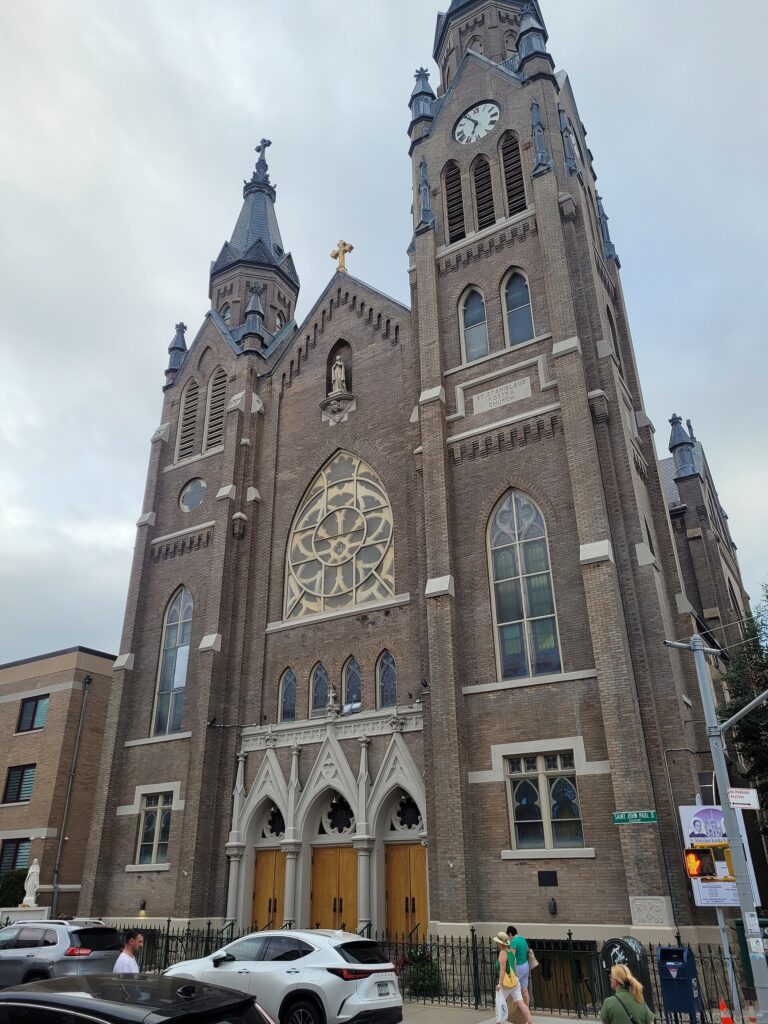
The church became the centre of community life. Saint Anthony of Padua Parish on Manhattan Avenue was founded in 1874. It served the neighbourhood’s earliest Polish families. Mass was said in Polish. Baptisms, first communions, funerals — all took place within those walls. The church gave the community an anchor.
How the Polish Community Organised and Survived
Polish immigrants in Greenpoint were not passive. They built institutions. They formed fraternal societies that offered sick pay and funeral benefits. These were essential before any social safety net existed.
The Polish National Alliance had a strong presence in Greenpoint. It provided insurance, advocated for workers’ rights, and organised cultural events. Polish dances, theatre performances, and lectures happened regularly throughout the year.
Polish immigrants also opened their own businesses. By the 1920s, there were Polish-owned pharmacies, insurance offices, travel agencies, and hardware stores on Manhattan Avenue. The community had begun to thrive on its own terms.
Want more stories like this? Our weekly newsletter goes deeper into New York’s heritage every week. It’s free. Subscribe here →
Greenpoint also had strong ties to the Jewish communities of the Lower East Side. Both groups worked in similar industries. Both faced discrimination from employers and landlords. Shared hardship sometimes created unexpected bonds.
The Post-War Years and a Second Renaissance
World War Two devastated Poland. Nazi occupation, the Holocaust, and Soviet domination followed one after another. Many Poles who had fled to Britain or elsewhere in Europe did not return. Some eventually made their way to New York.
A third wave of Polish immigration reached Greenpoint in the late 1940s and early 1950s. These were often displaced persons — survivors of camps, veterans, refugees. They arrived with trauma that was rarely spoken of. But they rebuilt. They found the same streets, the same churches, the same smells from the bakeries on Manhattan Avenue.
Greenpoint remained deeply Polish through the 1960s and 1970s. When other immigrant communities dispersed to the suburbs, the Polish community largely stayed. The neighbourhood had a coherence that resisted assimilation. Older residents spoke Polish at home. The younger generation straddled two worlds.
The fourth wave came after 1989. Poland shed communism. Young Poles could now leave freely. Many came to New York. Greenpoint was the obvious destination. This wave brought new energy. Polish restaurants opened. Polish clubs started again. The community refreshed itself.
What the Irish, Italian, and Polish Communities Shared
New York’s immigrant story is never just one group’s story. The same streets held many layers of history. The Irish in Five Points faced similar obstacles a generation earlier. Italian immigrants in Little Italy navigated similar prejudice.
What linked these communities was not language or religion alone. It was the structure of their experience. The factory work. The tight neighbourhoods. The deep faith. The fierce pride. Each group built something durable from very little.
Reading about how to trace your New York City ancestry can help you connect your own family to stories like these. Many Greenpoint families left records at Polish churches, the New York City Department of Records, and the YIVO Institute for Jewish Research.
Where to Visit Greenpoint Today
Greenpoint has changed. Rents are higher now. Young professionals have moved in alongside long-term residents. But the Polish community has not vanished. It has adapted.
Manhattan Avenue remains the heart of Polish Greenpoint. Walk between Greenpoint Avenue and Nassau Avenue. You will still find Polish delicatessens, bakeries, and restaurants. Stop at a Polish deli for smoked kielbasa or fresh pierogi.
Saint Anthony of Padua Roman Catholic Church on Manhattan Avenue has served this community since 1874. It is a beautiful, austere building. Mass is still celebrated in Polish on some Sundays. The church hall hosts cultural events throughout the year.
Karczma Polish Restaurant on Nassau Avenue is one of the most beloved Polish restaurants in the city. It opened in 2008. It serves bigos, gołąbki, and house-made pierogi. Weekend evenings bring Polish folk music. It feels entirely authentic.
Peter Pan Donut and Pastry Shop on Manhattan Avenue has been a Greenpoint institution since the 1950s. It is not specifically Polish — but it is the kind of small, family-run shop that Polish immigrant families built their lives around. Go early. The glazed doughnuts sell out.
Eagle Street and the East River waterfront offer a reminder of what first drew Polish workers to Greenpoint. The factories are gone. In their place are community gardens, a converted pier, and views across the river to Manhattan. Stand there and imagine what the skyline looked like to someone arriving by steamship in 1890.
Frequently Asked Questions
When did Polish immigrants first arrive in Greenpoint, Brooklyn?
The first significant wave of Polish immigrants reached Greenpoint in the 1870s and 1880s. They were drawn by factory work in the neighbourhood’s oil refineries, glassworks, and foundries.
Is Greenpoint still a Polish neighbourhood today?
Yes, though it has changed considerably. Polish delicatessens, bakeries, restaurants, and Catholic churches continue to serve the community. Manhattan Avenue remains the centre of Polish Greenpoint, and Polish is still spoken in many local businesses.
What can visitors see to experience Polish heritage in Greenpoint?
Visit Saint Anthony of Padua Church (founded 1874), walk Manhattan Avenue for Polish delis and bakeries, and dine at Karczma Polish Restaurant on Nassau Avenue. The former industrial waterfront on Eagle Street also connects visitors to the world Polish workers inhabited.
How can I trace Polish ancestry connected to Greenpoint?
Start with baptism, marriage, and burial records at local Polish Catholic churches, particularly Saint Anthony of Padua. New York City Department of Records holds vital records from the late 19th century onwards. The YIVO Institute holds records relevant to Eastern European Jewish families in the same era.
Ready to explore the New York your ancestors knew? Subscribe to Love New York — free weekly stories, heritage guides, and hidden history. Join us →

Subscribe Free