
Manhattan’s Little Italy is on Mulberry Street in Lower Manhattan. At its peak around 1900, over 10,000 Italian immigrants lived on a few blocks here. They built churches, bakeries, and social clubs. They raised children. They buried their dead. And they held on through poverty and hate.
Today, Little Italy is just three blocks long. The flags still hang. The coffee still flows. But the people who built it are mostly gone — spread across New York’s boroughs and beyond.
This is their story. Where they came from, how they lived, and what you can find there today.
If you love New York’s hidden stories, you’ll love our free weekly newsletter. Subscribe to Love New York →
The Wave That Changed Lower Manhattan
Italians began to arrive in New York in the 1870s. At first it was a trickle. Then it became a flood.
Between 1880 and 1914, four million Italians crossed the Atlantic. Most came to New York. They were from the south — from Sicily, Calabria, Campania, and Basilicata. These were not rich families. They were farm workers from a very poor region.
A blight had killed the vines. Land reform had failed. Whole villages sold what they had to buy a ticket on a ship.
They landed at Ellis Island. Officials wrote down their names. They often got them wrong. Then they were let out onto the Manhattan docks. Many had no money left. Many spoke no English. But they knew where to go.
Word had spread across whole towns in Italy: Mulberry Street. Go to Mulberry Street.
A City Within a City
Little Italy was not just “Italian.” It was a patchwork of small villages moved to Manhattan.
People from the same town in Italy lived on the same block in New York. Sicilians from Palermo were on Mulberry Street. Neapolitans were near Grand Street. Calabrians from their own towns lived on Elizabeth Street. Each block had its own dialect. Its own saints’ days. Its own bonds and its own grudges.
This made sense. You could only trust people you knew. You could only speak to people who knew your dialect. And you needed them around you when things went wrong.
The streets were packed. Families of eight and ten shared one-room flats. Street vendors lined the pavements. Fish sellers, bread men, and cloth dealers shouted in a dozen Italian dialects. The noise never stopped. The smells were strong.
Life was hard. But it was alive in ways the old farms had not been for years.
What They Faced
Italian immigrants were not made to feel welcome. They were called “dagos” and “wops.” The press drew cruel pictures of them. Bosses paid them the lowest wages. They were shut out of better-paid trades.
In 1891, eleven Italian men were lynched in New Orleans. This came after a murder trial. It was one of the largest mass killings of this kind in U.S. history. In New York, Italian immigrants were often blamed for crime by the press.
But they endured. They built mutual aid clubs. Each part of Italy had its own. Members paid small monthly dues. In return, they got help in times of illness. They got loans when money ran out. And they got a proper burial when they died. These clubs were the only safety net most families had. The city did not help them.
By the end of World War One, the Italian community had dug in. It had lived through hate, poverty, and twenty years of hard work. It was ready to build something that would last.
Want more stories like this? Our weekly newsletter goes deeper into New York’s heritage every week. It’s free. Subscribe here →
The Feast of San Gennaro
In September 1926, people from the Naples region brought a beloved tradition to Mulberry Street.
The Feast of San Gennaro began as one day. It marked the feast day of the patron saint of Naples — the 19th of September. Altars went up in the street. Candles were lit. The statue of San Gennaro was carried through the streets. Food was cooked and shared with neighbours.
The tradition grew. Each year, more stalls appeared. More families came. More visitors arrived from across the city.
Today, the Feast runs for eleven days in September. It is the largest Italian-American street feast in the United States. More than one million people come each year. Mulberry Street closes to traffic. The red, white, and green flags take on new meaning.
If your family came from Italy, the Feast in September is a moving experience. The same customs brought from Naples in 1926 are still observed — on the same street, in the same week.
The Neighbourhood Shrinks
By the 1950s, the children of Italian immigrants were leaving Little Italy. They had saved enough to move to Brooklyn, Queens, and Long Island. They wanted real houses, not tenements. They wanted gardens and space and good schools for their children.
The flats they left were taken by new arrivals. Chinatown, which had long sat to the south, began to grow north. Block by block, things changed. Italian-owned shops became Chinese-owned. The Italian people left.
Today, Little Italy is about three blocks of Mulberry Street, between Canal and Spring. A few Italian families still live there. The cafés and shops keep the name alive, though most now serve tourists rather than a true Italian community.
The area that once held 10,000 Italian immigrants now holds very few Italian families at all. It has become a memory — vivid, and still worth visiting.
Where to Visit Today
These are the places most tied to the Italian immigrant story:
Old St Patrick’s Cathedral — 263 Mulberry Street. Built in 1815. This was New York City’s first Catholic church before the Fifth Avenue building was raised. It became the parish church of the Italian community. Whole generations had their children baptised here, got married here, and held funerals here. The tombs beneath hold some of New York’s earliest Catholic clergy. Guided tours run most days.
Ferrara’s Bakery — 195 Grand Street. Founded in 1892. Enrico Ferrara came from Naples and opened this shop. For over a century it served local Italian families. Today it is one of the most visited Italian bakeries in New York City. The cannoli are made to the same recipe.
Alleva Dairy — 188 Grand Street. Founded in 1892. It is said to be the oldest Italian cheese shop in the United States. Fresh mozzarella and ricotta are still made here in the old way. The family came from Campania.
The Italian American Museum — 155 Mulberry Street. This small, excellent museum tells the story of the area and of the Italian immigrant experience. Old photos from the early 1900s show the streets as they were. Records, objects, and personal accounts bring the community back to life. If you are tracing family roots, start here.
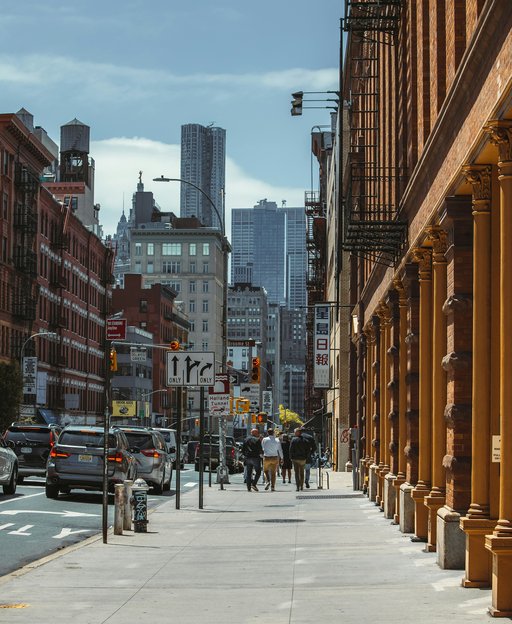
Mulberry Street itself — The street has changed greatly. But the scale and shape of the blocks are the same as in 1900. The old tenement buildings still stand. The fire escapes are still there. Walk slowly. It is easy to picture the streets as they were — loud, full of people, and alive with a dozen dialects.
Tracing Your Italian New York Roots
If your surname ends in a vowel, your family may well have lived on these streets. Common names in the old neighbourhood included Esposito, Romano, Ferraro, Russo, Conte, Bruno, Mancuso, Lombardi, and Ricci, among hundreds more.
Start with Ellis Island records. The database at libertyellisfoundation.org lets you search by name. You can find the ship your ancestor arrived on, the date, their age, and the town in Italy they came from.
Then look at U.S. Census records from 1900, 1910, and 1920. These show residents by street address. You may find your family listed on a block of Mulberry, Grand, or Elizabeth Street.
Our full guide to tracing New York City ancestry covers every record source. It walks you through the whole process step by step.
The story of Italian arrival overlaps with the wider immigrant history of Lower Manhattan. The Lower East Side’s Jewish community grew up just a few blocks to the east at the same time. The Irish who built Five Points had changed the same streets a generation before. This corner of Manhattan has seen more new arrivals than almost anywhere else on earth.
If your family left Little Italy — as most did by the 1940s — the Belmont area of the Bronx is where many of them went next. The Arthur Avenue area there still has a living Italian-American community, far more intact than Manhattan’s Little Italy today.
Frequently Asked Questions
What is Little Italy in Manhattan and where is it?
Little Italy is a historic area on Mulberry Street in Lower Manhattan, between Canal Street and Spring Street. It was the heart of Italian immigrant life in New York from the 1880s to the mid-20th century. A few original businesses and buildings still stand today.
When did Italian immigrants first arrive in Manhattan’s Little Italy?
Italian arrival in the Mulberry Street area began in the 1870s and grew fast through the 1880s. The peak years were 1900 to 1914. Tens of thousands of Italians from the south of Italy — mainly from Sicily, Calabria, and Campania — settled on a few blocks of Mulberry Street.
How big was Little Italy at its peak?
At its height in the early 1900s, Little Italy ran from Canal Street north to Houston Street and from Broadway east to the Bowery. More than 10,000 Italian immigrants lived on its densest blocks. Today, the area covers about three blocks of Mulberry Street.
When does the Feast of San Gennaro take place?
The Feast of San Gennaro takes place each September on and around Mulberry Street. It runs for about eleven days. The feast day itself is the 19th of September. The feast began in 1926 and is now the largest Italian-American street feast in the United States.
How do I find out if my Italian ancestors lived in Little Italy?
Start with Ellis Island records at libertyellisfoundation.org. Then search U.S. Census records from 1900, 1910, and 1920 for street addresses in the area. The Italian American Museum on Mulberry Street also has research resources. Our step-by-step New York ancestry guide covers the full process.
Ready to explore the New York your ancestors knew? Subscribe to Love New York — free weekly stories, heritage guides, and hidden history. Join us →
