
Your great-grandfather may have walked down Mott Street with a single bag and a borrowed name. Manhattan’s Chinatown began with people like him. They arrived with little money, and they built one of the oldest Chinese communities in the United States.
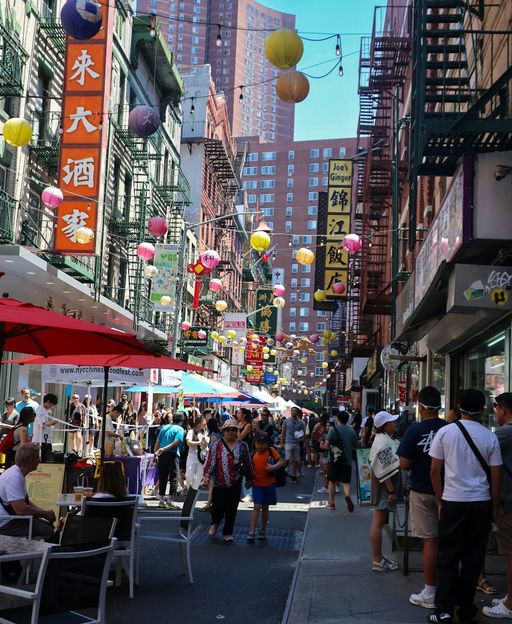
If your family came through Chinatown, this guide shows you where they lived, worked and prayed. It also shows you what survives today.
If you love New York’s hidden stories, you’ll love our free weekly newsletter. Subscribe to Love New York →
How Chinatown Began: Mott Street in the 1870s
The first Chinese New Yorkers came in the 1840s. Most were sailors and merchants. By the 1870s, a small community had settled around Mott, Pell and Doyers Streets.
Many came after work on the Western railroads dried up. They moved east looking for jobs. Chinese men opened laundries, restaurants and grocery stores. A laundry needed little money to start. A few tubs and an iron were enough.
The streets they chose had a history already. Irish families once crowded these blocks. Italian families followed them. Our guide to the Irish immigrants of Five Points tells the earlier chapter. Chinese newcomers rented rooms in the same old tenements.
Life Under the Exclusion Act
In 1882, Congress passed the Chinese Exclusion Act. It stopped Chinese labourers from entering the country. Congress renewed the ban and kept it in place until 1943.
The law shaped every family story. Most early residents were men. Wives and children could not join them. Chinatown became a “bachelor society” for decades.
Some families used “paper sons” to get around the law. A man claimed to be the son of a Chinese American citizen. He bought or borrowed the paperwork to prove it. Many families kept the false names for generations. If your surname does not match your grandfather’s village, this may explain why.
Men also built their own support networks. In 1883, the Chinese Consolidated Benevolent Association formed in New York. It settled disputes, helped the sick and sent money home. Family and district associations did the same work. Their signs still hang above shops along Mott and Bayard Streets.
Doyers Street and the Tong Era
Doyers Street bends sharply near its middle. Locals call the curve the “Bloody Angle”. Rival tongs fought here in the early 1900s. Newspapers loved the story and wrote about little else.
The real Chinatown was quieter than the headlines. Most people worked long hours in laundries and kitchens. They also ran theatres, tea rooms and newspapers.
One survivor stands at 13 Doyers Street. Nom Wah Tea Parlor opened in 1920. You can still sit down there for dim sum. Order a pot of tea and picture the room a century ago.
Work and Daily Life: Laundries, Kitchens and Rented Rooms
Chinese laundries spread across every New York borough by the early 1900s. A laundryman often worked sixteen hours a day. He slept in the back of the shop and sent most of his pay home.
Restaurants offered another path. Cooks and waiters worked long shifts, and they shared crowded rooms above the kitchens. A family of five might live in two rooms with a shared toilet down the hall.
Evenings brought a different pace. Men met at association halls to read letters from home and play cards. They shared news from their villages in Guangdong. Those halls kept a distant homeland close.
Families that did settle here raised their children between two worlds. Children spoke English at school and Cantonese at home. Many then translated for parents at the bank, the clinic and the courthouse. Ask any Chinese American New Yorker about their grandmother’s kitchen. You will hear how food held the family together.
Churches, Temples and the Church of the Transfiguration
The Church of the Transfiguration stands at 29 Mott Street. Lutherans built it in 1801. Catholics bought it in 1853. Its pews served Irish, then Italian, then Chinese parishioners. Few buildings in New York show the layers of immigration so clearly.
Chinese families also built Buddhist and Taoist places of worship. The Mahayana Buddhist Temple stands at 133 Canal Street. Its large golden Buddha sits just inside the door.
After 1943 and 1965: Chinatown Grows
Congress repealed the Exclusion Act in 1943. The law still allowed only a tiny number of Chinese immigrants each year. Then came the Immigration and Nationality Act of 1965. It ended the old quota system. Families who had waited for decades could finally reunite.
Chinatown grew fast. New arrivals came from Guangdong, then from Fujian and other regions. They spilled over Canal Street into Little Italy and the Lower East Side. Our guide to Manhattan’s Little Italy explains how that boundary shifted. The Jewish quarter next door changed too. Read about it in our Lower East Side history.
Want to picture daily life in these blocks? Try our portrait of New York tenement life in 1910.
Love stories like this? Our weekly newsletter goes deeper into New York’s heritage every week. It’s free. Subscribe here →
Where to Trace Chinese Heritage in Chinatown Today
- Museum of Chinese in America (MOCA), 215 Centre Street. Its exhibits cover family stories from the 1800s to now. Check the museum’s website for opening hours.
- Columbus Park, Mulberry Street. This park replaced the Mulberry Bend slum in the 1890s. Today neighbours play cards and practise tai chi here.
- Chatham Square. The Kim Lau Memorial Arch honours Chinese Americans who died in the Second World War. A statue of Lin Zexu stands nearby.
- Doyers Street. Walk the curve, then stop for tea at Nom Wah.
- Church of the Transfiguration, 29 Mott Street. Look up at the stonework and think about three centuries of newcomers.
- Family association signs. Walk Mott and Bayard Streets and read the upper-floor signs. Each one names a village or surname group.
How to Research a Chinese American Family in New York
- Start at home. Ask relatives for old papers, photographs and the Chinese characters of your family name.
- Search arrival records. The Ellis Island Foundation offers a free passenger database.
- Look for exclusion-era files. The National Archives at New York City holds Chinese Exclusion Act case files. Your ancestor may have a detailed interview on record.
- Check census returns. Name spellings vary a lot. Try several versions.
- Visit the museum. MOCA staff can point you to oral histories and community archives.
Found your roots? Plan your New York heritage journey with our free weekly guides.
Frequently Asked Questions
When did Chinese immigrants settle in Manhattan’s Chinatown?
A small community formed around Mott, Pell and Doyers Streets in the 1870s. It grew sharply after 1965, when new immigration rules let families reunite.
What was the Chinese Exclusion Act?
Congress passed it in 1882. It barred Chinese labourers from entering the country, and it stayed in force until 1943.
What is a “paper son”?
A paper son was a young man who entered the country on papers claiming a Chinese American father. Many families kept those names for generations.
What can visitors see in Chinatown today to trace its history?
Visit the Museum of Chinese in America on Centre Street. Then walk Doyers Street, Columbus Park and Chatham Square. Stop for dim sum at Nom Wah Tea Parlor.
How do I find my Chinese American ancestors in New York?
Start with family papers and Ellis Island records. Then search Chinese Exclusion Act case files at the National Archives at New York City.
Ready to explore the New York your ancestors knew? Subscribe to Love New York — free weekly stories, heritage guides, and hidden history. Join us →
For a visitor’s view of the neighbourhood, read our Chinatown guide for 2026.
