
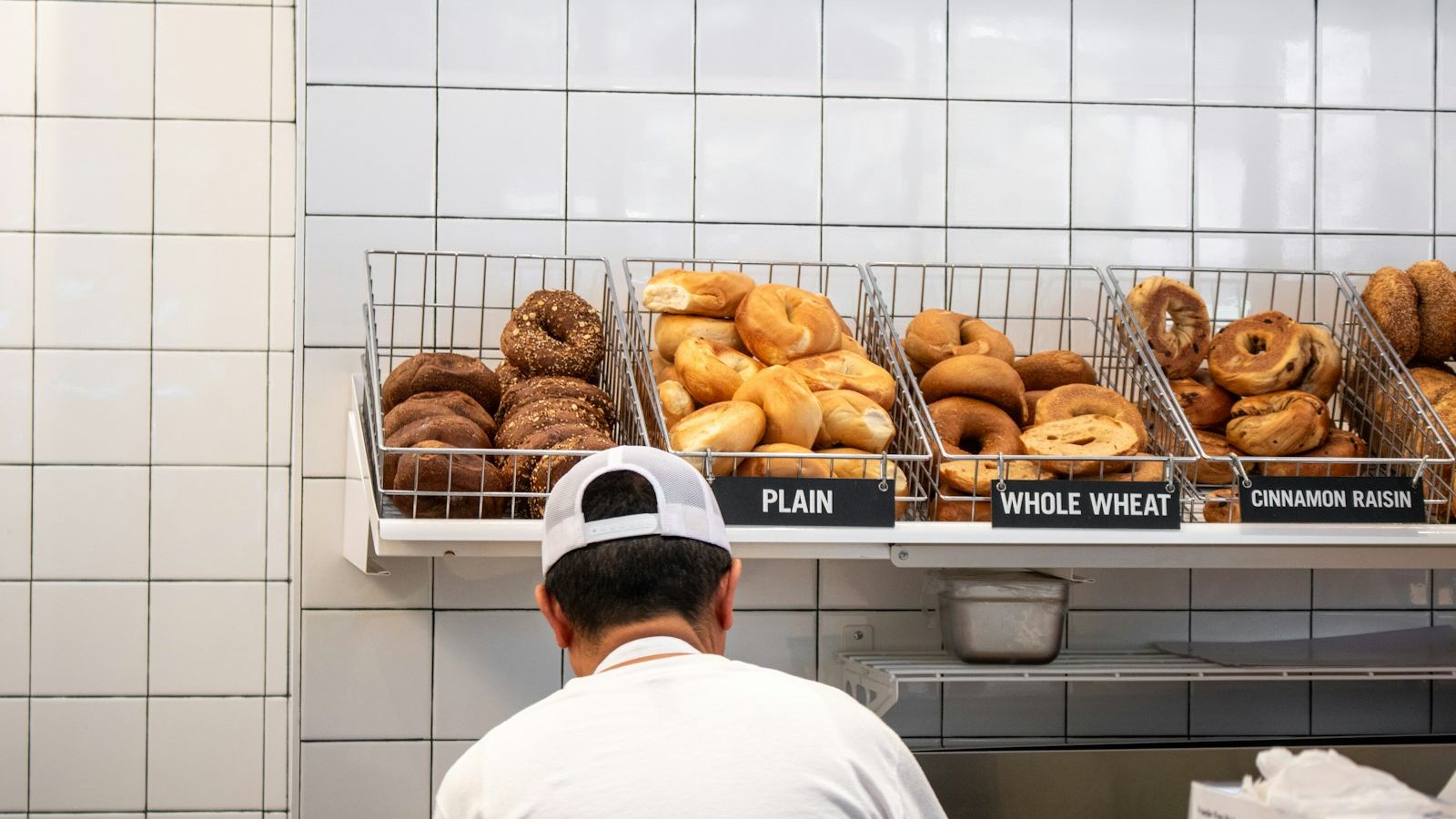
Ask any New Yorker about bagels and you’ll start an argument. Not a polite disagreement — a passionate, borderline-personal debate about who makes the best one, why the ones from your hometown don’t compare, and exactly what went wrong with every other attempt. The New York bagel isn’t just food. It’s identity, history, and a 130-year argument served on a round piece of bread.
From Eastern Europe to the Lower East Side
The bagel arrived in New York with Eastern European Jewish immigrants in the late 1800s. Bakers from Poland and Russia brought a bread tradition built around hand-rolling dough, boiling it in salted water, then baking it at high heat. The result was dense, chewy, and unlike anything else being sold on the streets of Manhattan.
By the early 1900s, the Lower East Side was alive with the smell of fresh bread. Bagels were cheap, portable, and deeply tied to the community that had brought them across the Atlantic. Street carts sold two for a penny along Orchard and Essex Streets, and entire blocks were organized around the bakeries that produced them.
It was food born of necessity — and it thrived. For more on the immigrant communities that shaped New York’s neighborhoods, read our piece on the fascinating decline of Little Italy.
The Secret Society That Ran the Bagel World
For much of the 20th century, the bagel trade in New York was controlled by one of the most tightly organized labor unions in the country: the International Bagel Bakers Local 338. At its peak, the union determined who could bake bagels in the city, how many were produced each day, and who could even learn the trade.
Membership was passed almost entirely through family connections. Baking techniques were closely guarded secrets. Non-union shops were effectively impossible to sustain. The union’s grip lasted for decades — until the 1960s, when commercial bakeries and automated bagel machines began breaking the old hand-rolling monopoly.
That transition marked the end of an era. But it also pushed the best traditional bakers to compete harder on quality — which is part of why the New York bagel reached the level of craft it’s known for today.
The Great New York Water Debate
No conversation about New York bagels goes far before someone raises the water question. The claim is simple: New York’s tap water, filtered through ancient Catskill Mountain reservoirs, has a mineral composition that makes dough behave differently from anywhere else.
Lower calcium and magnesium levels, the argument goes, produce a softer gluten structure and a chewier, more complex crumb. Bakers outside New York have tested this — importing the water, replicating its chemistry with additives. Results are genuinely mixed. Some swear it matters enormously. Others say technique and flour type are the real variables.
The debate continues, which is exactly how New Yorkers like it. Just like the mystery of why New York pizza tastes different everywhere else, the water theory is part science and part city mythology — and New York wouldn’t have it any other way.
Enjoying this? Join New York lovers getting stories like this every week. Subscribe free →
The Bagel Wars
By the 1970s and ’80s, the bagel had gone mainstream — but New Yorkers still had fierce, almost tribal loyalties. H&H Bagels on the Upper West Side, open 24 hours, became legendary for its glossy, malt-sweetened specimens. Ess-a-Bagel in Midtown built a following through enormous, aggressively chewy versions that required two hands. Russ & Daughters on the Lower East Side kept the old tradition alive with lox-and-cream-cheese combinations unchanged for generations.
Each had devotees who would walk 20 blocks out of their way to avoid the wrong one. That tribalism — passionate, local, completely irrational — is still one of the most New York things about the whole institution.
What Makes a Real New York Bagel
The short answer: it’s baked fresh, sold warm, and eaten the same day. A genuine New York bagel has a deep brown, slightly glossy exterior from the boiling process, a chewy-not-tough crumb, and a subtle sweetness from malt syrup in the water bath.
If a bagel is pre-sliced, pre-packaged in cellophane, or sitting on a shelf at room temperature, it isn’t a New York bagel. It’s a bread product with an identity crisis. Today’s best options include Ess-a-Bagel, Russ & Daughters, Tal Bagels, and Black Seed Bagels — which blends Montreal-style wood-fired baking with the New York tradition to create something genuinely worth arguing about.
For a full guide to the city’s most iconic bites, our New York City food guide covers where to eat across all five boroughs.
What makes New York bagels different from bagels everywhere else?
New York bagels are made with high-gluten flour, hand-shaped (or shaped using traditional techniques), boiled in malt-sweetened water before baking, and finished at high heat. This process creates the dense, chewy crumb and glossy crust that bagels elsewhere — especially mass-produced versions — struggle to replicate. New York’s water chemistry may also play a small role.
Where can I find the best bagels in New York City?
Ess-a-Bagel, Russ & Daughters, Tal Bagels, and Black Seed Bagels are among the most respected shops. H&H Bagels on the Upper West Side is a classic institution. Always look for bagels baked fresh the same morning — if they’re warm when you get them, you’re in the right place.
What is the best time to visit a bagel shop in New York?
Early morning is best — most traditional bagel shops start baking before 7am and the first batches are out by 8am. Weekends are busiest at Lower East Side institutions, so arrive before 9am to beat the queue and get the freshest bagels of the day.
Is the New York water theory about bagels actually true?
It’s been genuinely tested and remains debated. New York tap water has a specific low-mineral profile — less calcium and magnesium than most cities — which may produce a softer gluten structure in dough. Most bakers agree technique and flour matter more, but water likely plays some role in the final texture.
The New York bagel has survived centuries of immigration, union politics, automation, and every artisan bread trend that threatened to replace it. It’s outlasted the pushcart era, the bagel wars, and the rise of boutique baking. Some foods are just too embedded in a city’s identity to ever really lose their place.
Next time you’re in New York, find the best bagel shop you can, get there early, and have a very strong opinion about which one is right. You’ll fit right in.
You Might Also Enjoy
- The Real Reason New York Pizza Tastes Different From Everywhere Else
- The New York Drink With No Egg and No Cream — and a History Nobody Agrees On
- What Happened to Little Italy? The Story Behind New York’s Most Bittersweet Block
Plan Your New York Trip
Ready to explore New York’s food scene in person? Our complete New York City food guide has everything you need — from neighborhood specialties to the best markets, delis, and must-try dishes across all five boroughs.
Join 1,100+ New York Lovers
Every weekday morning, get New York’s hidden gems, neighbourhood stories, food origins, and city secrets — straight to your inbox.
Subscribe free — enter your email:
📲 Know someone who’d love this? Share on WhatsApp →
Love more? Join 65,000 Ireland lovers → · Join 43,000 Scotland lovers →
Free forever · Unsubscribe anytime

Subscribe Free