
In 1966, Andy Warhol arrived at 222 West 23rd Street with a camera crew, not a reservation. The result was Chelsea Girls, a 200-minute underground film that became one of the most-discussed American movies of the year. He hadn’t booked rooms. He’d just known the Chelsea would let him in.
That was the point. It always had been.
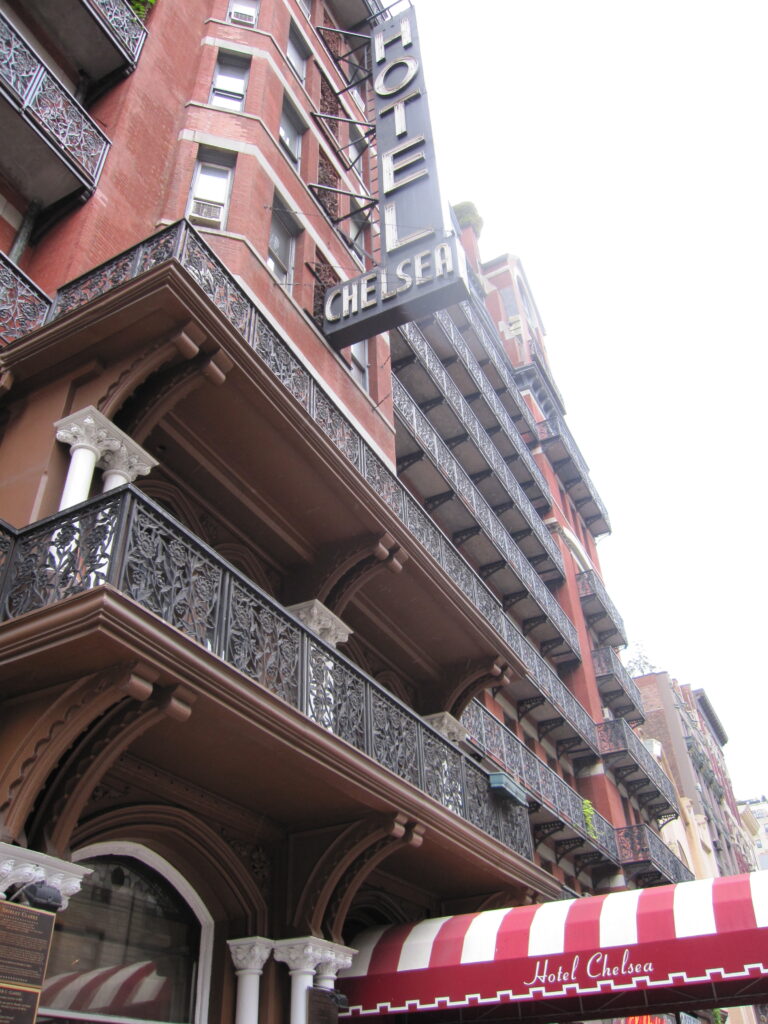
The Hotel That Ran on Art
The Hotel Chelsea opened in 1884 as a cooperative apartment building — one of the first in New York City. When the cooperative failed and it became a hotel in 1905, the building kept its soul: a tolerance for people who lived unconventionally, paid irregularly, and created constantly.
Under the long management of Stanley Bard, an informal policy became a quiet institution. Artists who couldn’t pay rent could offer artwork instead. Paintings, sculptures, photographs — they went straight onto the walls.
Today, hundreds of pieces still hang in the lobbies and stairwells. The hotel owns work by artists who once couldn’t afford a meal. The Chelsea became a living gallery before anyone had that concept.
The Names That Walked Through the Door
The guest register reads like a fever dream of 20th century culture.
Thomas Wolfe wrote You Can’t Go Home Again in room 829. Tennessee Williams was a regular. Arthur Miller moved in after his divorce from Marilyn Monroe and found the anonymity he needed to write. Dylan Thomas spent his final days here before his death in 1953.
In the 1960s, the music arrived. Bob Dylan worked on songs in these rooms during his early New York years. Leonard Cohen composed “Chelsea Hotel #2” about Janis Joplin in one of its corridors — a song so specific you can almost hear the elevator doors. Jimi Hendrix passed through.
Patti Smith lived here with photographer Robert Mapplethorpe in the early 1970s and later wrote the memoir Just Kids about those years — a portrait of the Chelsea as much as of any two people. William S. Burroughs kept a room here for years. Arthur C. Clarke wrote 2001: A Space Odyssey while looking out over West 23rd Street.
None of this was accidental. The Chelsea attracted people who needed space — physical and creative — more than they needed luxury. If you want to follow this thread further, the story of the Greenwich Village writers who shaped the same era unfolds just a few blocks south.
What Stanley Bard Understood
Get our free Hidden Gems of New York guide →
Bard managed the Chelsea for five decades. He knew his tenants by name, knew their work, knew when they were struggling. The hotel under his watch functioned as an unplanned artists’ residency — decades before such programs existed.
Writers slipped manuscripts under each other’s doors. Musicians jammed in the corridors. Filmmakers screened rough cuts in the lobby. The Algonquin Round Table had its formal lunches across Midtown — the Chelsea had something looser and stranger: an entire building that ran on creative energy instead of commerce.
The artwork-as-rent system wasn’t charity. It was a bet. Bard accepted work he believed in, from people he believed in. The collection on the walls today represents some of those bets paying off — and many others that simply made the building more beautiful.
A Living Archive
Walk into the Chelsea today and the lobby is still startling. Pieces crowd the walls floor to ceiling. There are no neat labels or clean sightlines — just work, everywhere, placed by people who once lived in the rooms above.
The building closed for renovation in 2011 after years of legal battles between long-term residents, the ownership board, and preservationists who feared the character would be gutted. It reopened as a fully functioning hotel in 2022.
The artwork stayed. The rooms were redesigned. The building still stands on West 23rd Street, red brick and ornate iron balconies, looking exactly like it did when the camera crews and poets and musicians first arrived. Andy Warhol’s Factory transformed an industrial space in the same spirit — turning a building into a way of life.
The Chelsea Today
Room 829. The corridors where Cohen walked. The lobby where Warhol set up his camera. The stairwells where the artwork still hangs, floor by floor, a record of every creative risk someone once decided to take.
You can book a room tonight if you want to. The hotel accepts credit cards now, not just paintings. But the walls hold everything that was left behind — decades of people who came to New York looking for a place that asked only one question: What are you working on?
For over a century, the Hotel Chelsea gave the right answer. It let them in.
You Might Also Enjoy
- Why Every American Writer in the 1950s Needed to Live in Greenwich Village
- The Lunch Table That Changed American Humor — and You Can Still Sit There Today
- Why Andy Warhol Covered His New York Studio in Tin Foil — and Changed Art Forever
Plan Your New York Trip
Ready to explore New York City for yourself? Our complete New York travel guide covers neighborhoods, insider tips, and everything you need to make the most of your visit.
Join New York Lovers
Every weekday morning, get New York’s lesser-known corners, neighborhood stories, food origins, and city secrets — straight to your inbox.
Subscribe free — enter your email:
Get the Free PDF Guide
Enter your email and we'll send it straight over.
Free forever · Unsubscribe anytime

Get our free Hidden Gems of New York guide →
Related
Other newsletters you might like
Irish Rugby Fans
The best Irish rugby updates, straight to your inbox — Six Nations, the Nations Championship and the provinces. Only when there's something worth reading.
SubscribeLove South Africa
South Africa as a travel destination. The Rainbow nation full of wonderful gems to visit. Going on Safari in the Kruger National Park, visiting the beautiful beaches of Cape Town, indulge in the South African culture and heritage.
SubscribeLove Castles
Apart from the fascinating and rich history of castles, people love to visit them for their majestic beauty. From the imposing stone walls to the beautiful architecture, there is something captivating about these grand structures.
SubscribeLove California
Love California — in your inbox The Pacific Coast Highway, national parks, beaches, wine country and the best places to visit in California. One short email, every day.
SubscribeNewsletters via the One Two Three Send network. · Want your newsletter featured here? Click here