
Vinegar Hill is a tiny Brooklyn neighborhood with a big Irish past. Irish families once filled its brick row houses. They worked at the Navy Yard next door and called the place Irishtown. The streets are still there, and you can walk them in about an hour.
If you love New York’s hidden stories, you’ll love our free weekly newsletter. Subscribe to Love New York →
Where Is Vinegar Hill, Brooklyn?
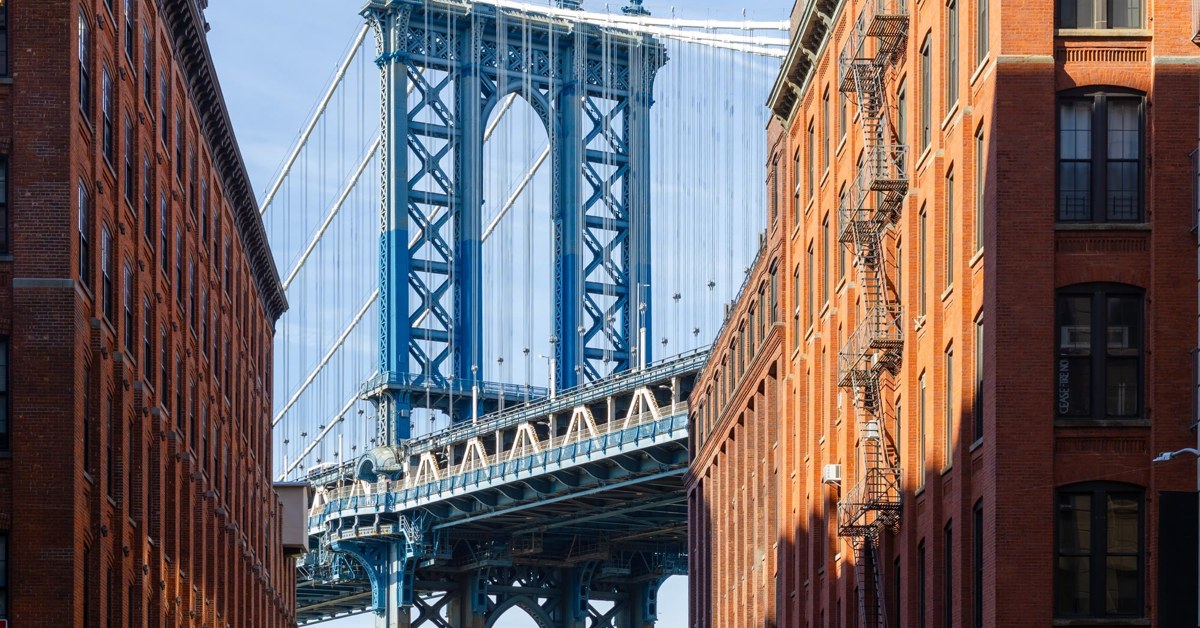
Vinegar Hill sits on the East River waterfront. Dumbo lies to the west. The Brooklyn Navy Yard lies to the east. The neighborhood covers roughly six blocks, so it feels more like a village than a district. The photo above shows Dumbo, just next door, where the same brick warehouses meet the water.
The area was bigger once. Before the Brooklyn-Queens Expressway went up in the 1950s, it reached south to Tillary Street. The highway cut away part of the old Irish neighborhood. What remains is the core around Hudson Avenue, Plymouth Street, Water Street and Front Street. This neighborhood history lays out the boundaries and the sources.
Why Did Irish Immigrants Call It Vinegar Hill?
The name comes from Ireland. Vinegar Hill is a hill near Enniscorthy in County Wexford. A battle there in 1798 made the name famous across Ireland and among Irish people abroad.
John Jackson owned land beside the Navy Yard. He sold part of it to the federal government for the yard itself. He then built housing for the workers. He gave the area its Irish name, hoping to attract Irish settlers. His plan worked. Irish families moved in, and the nickname Irishtown stuck.
Other groups came too. Germans, Norwegians and Poles all settled here. Irish residents still gave the neighborhood its character.
What Was Life Like for Irish Families Here?
Most men worked close to the water. The Navy Yard and the shipyards gave steady jobs to carpenters, riggers and laborers. Women kept boarding houses, took in laundry and raised large families in small rooms.
Think about the daily routine. A man walked a few blocks to the gate. His wife shopped on the corner and chatted with neighbors from the same county back home. Church bells set the rhythm of the week. Everyone knew everyone.
Money was tight. Some residents turned to a home-made whiskey called poitín, which New Yorkers spelled “potheen.” Alcohol was legal but heavily taxed, so illegal stills paid well. After the Civil War, the new Bureau of Internal Revenue sent former soldiers into the neighborhood to smash the stills. The raids became local legend.
Want to know how Irish New Yorkers lived before this? Read our story of Five Points, the first Irish New York. Many families moved from Manhattan’s crowded slums to Brooklyn’s waterfront as work shifted.
How Did Vinegar Hill Change Over Time?
Change came in waves. The Navy Yard shaped the first wave of settlement. Heavy industry shaped the next. Factories, warehouses and power plants crowded the shoreline, and the neighborhood took on an industrial look.
Then the expressway arrived. Its construction in the 1950s cut away the southern part of the old neighborhood. If your family lived south of the present-day core, expect the block to look very different, or to be gone.
Today the neighborhood is quiet and small. A 1999 New York Times article, cited in the neighborhood history above, described a place where residents know one another. That closeness echoes the village feeling of Irishtown. Your ancestors would recognize the pace of the streets, even if the shops look different.
Why does this matter to a family historian? Small neighborhoods leave sharp records. A single block can appear in dozens of census pages. Once you find one relative here, you often find cousins, in-laws and neighbors from the same Irish parish within a few doors.
What Can You Still See Today?
The best sight is the architecture. Builders put up most of the houses in the 1840s and 1850s. They used the Greek Revival and Federal styles. You will see plain brick fronts, tall windows and stoops.
Look down as well. Hudson Avenue, Plymouth Street, Water Street and Front Street have Belgian block paving. Locals call it cobblestone, but Belgian block is the correct term. These streets look much as they did when your ancestors walked them.
Near Evans and Little Streets, beside the Navy Yard, stands a Federal-style mansion called Quarters A, also known as the Commandant’s House. Builders finished it in 1805. Commodore Matthew C. Perry once lived there. You can view it from the street.
The neighborhood also holds a landmark designation. The Vinegar Hill Historic District protects the old rows. For the rules and history of landmark districts, see the NYC Landmarks Preservation Commission.
Be aware that a large Con Edison generating station sits on Hudson Avenue. It gives the area a gritty, industrial feel. That is part of the story. Vinegar Hill was always a working place.
Want more Brooklyn stories? Our Greenpoint Polish heritage story and our guide to Sunset Park follow other waterfront families.
Want more stories like this? Our weekly newsletter goes deeper into New York’s heritage every week. It’s free. Subscribe here →
How to Trace Your Irish Family in Vinegar Hill
Start at home. Ask relatives for old addresses, church names and the names of ships. Then work backward through the records.
Census returns list a street address and a job for each household. Look for “Navy Yard,” “laborer” or “seaman” next to a Brooklyn address. City directories help too. They list residents by name and street.
Birth, marriage and death certificates give parents’ names and often a county of origin. The NYC Department of Records and Information Services holds the city’s municipal archives. Check its site for what you can search online and what you must request.
For the full method, read our step-by-step guide to tracing your New York City ancestry. If your family arrived before 1892, also see our Castle Garden story.
Plan Your Heritage Visit
Take your family notes. Walk Hudson Avenue first. Then turn along Plymouth and Water Streets toward the Navy Yard. Stop at each corner and read the house numbers. If your ancestors lived here, you may find their very block.
Allow about an hour. Wear comfortable shoes, because the Belgian blocks are uneven. Bring a camera and a notebook. Photos of a family block become treasured keepsakes.
Add Dumbo and the waterfront to the same afternoon. They sit within easy walking distance. The Brooklyn waterfront shows how the whole shoreline once worked.
Frequently Asked Questions
Why is it called Vinegar Hill in Brooklyn?
It takes its name from Vinegar Hill near Enniscorthy in County Wexford, Ireland. Landowner John Jackson used the name to attract Irish settlers to the land beside the Navy Yard.
Where is Vinegar Hill in Brooklyn?
It lies on the East River waterfront between Dumbo and the Brooklyn Navy Yard. The core is about six blocks, centered on Hudson Avenue.
Can I still see Irish heritage in Vinegar Hill today?
Yes, in the buildings and streets. The 19th-century row houses, the Belgian block paving and the Commandant’s House near the Navy Yard all date from the Irish era. The landmark district protects the old rows.
How do I find out if my ancestors lived in Vinegar Hill?
Search census records and Brooklyn city directories for a Navy Yard worker or laborer at a Vinegar Hill address. Then check vital records for parents’ names and home counties.
Ready to explore the New York your ancestors knew? Subscribe to Love New York — free weekly stories, heritage guides, and hidden history. Join us →
