
Every day, thousands of people climb the marble steps past the famous stone lions and walk right into one of the most extraordinary buildings in America. Most of them have no idea what they’re standing above.
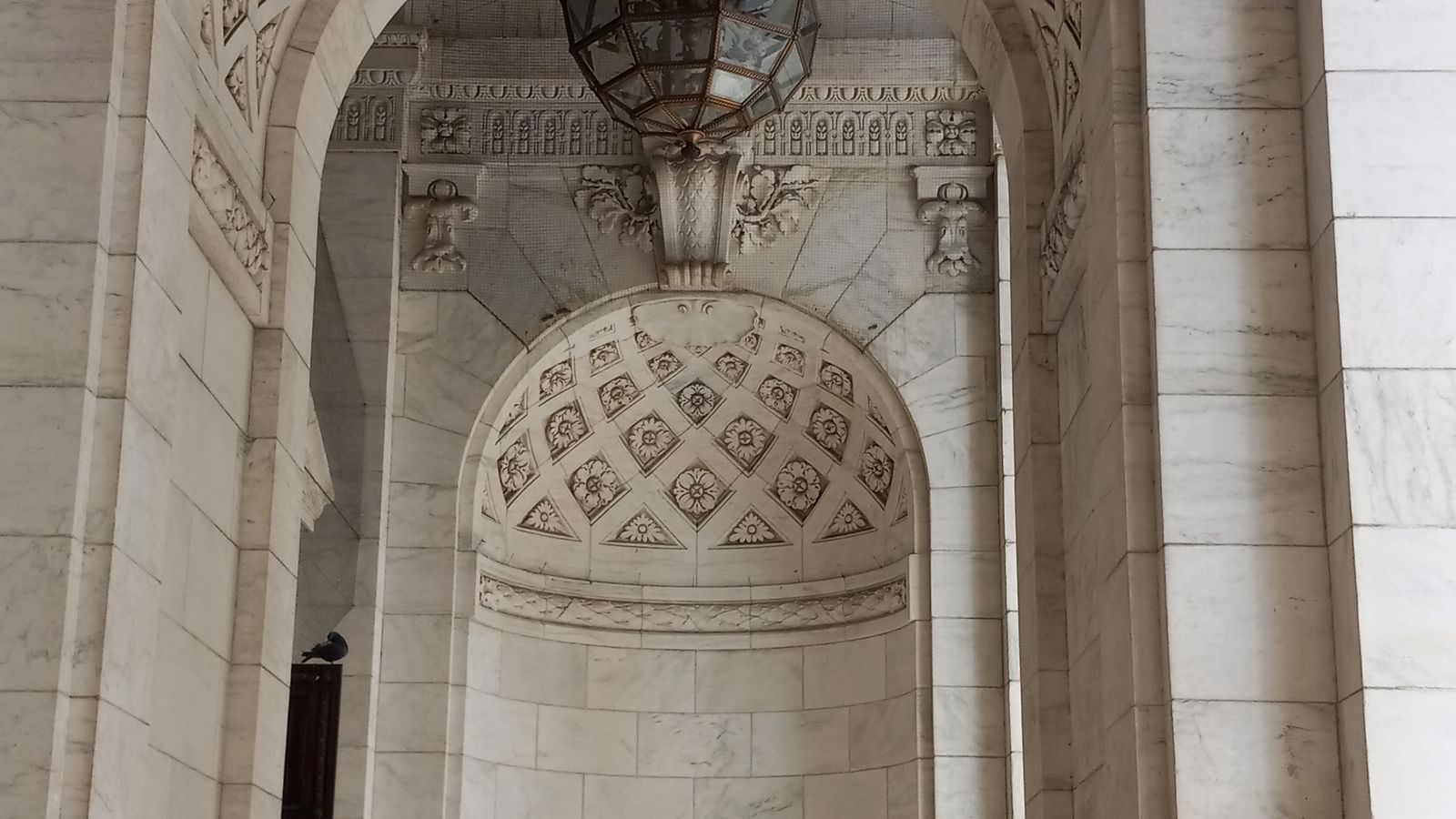
The New York Public Library on Fifth Avenue isn’t just a building where people read books. It’s a place built on a vanished lake, staffed by tunnels and machines, and hiding one of the most magnificent rooms in the Western Hemisphere behind a set of unremarkable bronze doors. Most visitors walk straight past it.
The City’s Water Supply Is Buried Beneath It
Before the library, there was a reservoir. A massive Egyptian-revival stone fortress, built in 1842, that stored Manhattan’s drinking water. It held 20 million gallons. New Yorkers used to promenade along the top of its 50-foot-high walls on Sunday afternoons, looking out over the city.
By the 1890s, the reservoir was obsolete. The city tore it down. On the emptied site — between 40th and 42nd Street, Fifth Avenue to Sixth — they built the library.
The building that replaced it opened in 1911 and took 14 years to construct. Architects Carrère and Hastings clad it in Vermont marble, filled its interior with hand-painted ceilings and gilded arches, and created something that looked more like a palace than a public institution. Which was entirely the point.
The Underground World Beneath Bryant Park
Here’s what most people don’t know. The building extends downward as dramatically as it rises upward.
Beneath the library and running below the full length of Bryant Park next door, engineers constructed enormous underground stacks — floor after floor of shelving holding millions of books, maps, photographs, and manuscripts. The stacks ran seven levels deep, suspended in a climate-controlled world that most New Yorkers have never seen and never will.
When a reader in the main reading room requested a book, they filled out a slip of paper. That slip traveled via pneumatic tube to the stacks below. A librarian retrieved the item and loaded it onto a mechanical conveyor system — a kind of underground railway for books — that delivered it upstairs in minutes. The whole invisible machinery of it hummed beneath the city streets while readers sat in comfortable chairs, utterly unaware.
The Lions and What Their Names Tell You
Most people know the lions. They guard the front steps, each weighing 7.5 tons of pink Tennessee marble. They were carved in 1911 and became one of the most recognizable symbols of New York City.
But their names have a story. When the library first opened, the lions were called Leo Astor and Leo Lenox — after John Jacob Astor and James Lenox, two of the private collectors whose donated libraries formed the foundation of the New York Public Library’s collection.
Then came the Depression. Mayor Fiorello La Guardia renamed them Patience and Fortitude — the two qualities, he said, that New Yorkers would need to survive the economic catastrophe unfolding around them. The names stuck. They still wear them today.
Enjoying this? Join New York lovers getting stories like this every week. Subscribe free →
The Room Most People Rush Through
The Rose Main Reading Room on the third floor is 297 feet long, 78 feet wide, and 52 feet high. That’s longer than a football field. The painted ceiling was restored for years after 1992, when plaster began falling.
Sixteen enormous chandeliers hang above long oak tables where New Yorkers have been writing, studying, and staring into the middle distance since 1911. Tourists walk in, take a photo, and walk back out. The people who actually sit down and stay — they know something.
The room was designed with the deliberate intention that ordinary citizens should feel the same sense of grandeur that wealthy people experienced in private libraries and gentlemen’s clubs. Everything about its scale is a democratic statement made in marble and paint.
The Treasures Hidden in Plain Sight
The library’s collections contain roughly 55 million items. Most are stored offsite. But the main branch keeps some of its most extraordinary holdings on rotating display, and very few visitors go looking for them.
The library holds one of the original Gutenberg Bibles — one of fewer than 50 surviving copies in the world. It holds the manuscript of Virginia Woolf’s diary. It holds Harry Houdini’s personal collection of books on magic and the occult, which he donated before his death. It holds one of the oldest maps in existence to show the New World.
These things sit in a building that anyone can walk into, for free, on any weekday. You need only to know they’re there and to look for the exhibition rooms. Most people walk past them on the way to the reading room selfie.
A Building That Belongs to Everyone
The New York Public Library was built on a radical premise: that knowledge and beauty belonged to everyone, not just those who could afford private collections. The marble and the painted ceilings weren’t for show. They were a political act.
Sitting in that reading room — with the chandeliers above you, the oak table beneath your hands, and seven floors of books somewhere below your feet — you feel it. The city took the place where it once stored water and decided to store something it valued more.
There are many hidden corners of this city that reward the curious visitor. But few of them are this easy to find — and this thoroughly overlooked.
You Might Also Enjoy
- Hidden Gems in NYC: The New York Most Tourists Never See
- The Secret Courtyards Hiding Right in the Middle of New York City’s Busiest Blocks
- Free Things to Do in NYC: The Best No-Cost Experiences in New York City
Plan Your New York Trip
The library is free to enter and open to all. For everything else you need to know before your visit, our New York City travel tips guide covers the essentials — from getting around to the neighborhoods worth exploring on foot.
Join New York Lovers
Every weekday morning, get New York’s hidden gems, neighbourhood stories, food origins, and city secrets — straight to your inbox.
Subscribe free — enter your email:
Love more? Join 65,000 Ireland lovers → · Join 43,000 Scotland lovers →
Free forever · Unsubscribe anytime
