
In 1928, John D. Rockefeller Jr. signed a lease on 12 acres of Midtown Manhattan. The plan was straightforward: a gleaming new home for the Metropolitan Opera. Then the stock market crashed, America fell into the Great Depression, and the Opera walked away.
But Rockefeller couldn’t walk away. The lease was unbreakable. So instead of a concert hall, he decided to build something the world had never seen before.
The Deal That Changed Midtown Forever
Rockefeller inherited his father’s fortune — and his stubbornness. Trapped in a lease for land that was then a mix of brownstones, boarding houses, and speakeasies, he made a decision that shocked his advisors.
He would build a commercial complex — a self-contained city in the heart of Manhattan.
Ground broke in 1930. The timing could not have been worse. Millions of Americans were out of work. Banks were closing. And here was one of the richest men in the country, pouring money into concrete and steel in Midtown. But that’s exactly what made it matter.
Building While America Was Falling Apart
At its peak, Rockefeller Centre employed tens of thousands of construction workers — men who desperately needed the wages. Over nearly a decade, they built 14 Art Deco towers on a scale the city had never attempted.
The project was not just enormous. It was obsessive in its detail. Every lobby, every panel, every carved archway was deliberate. Rockefeller hired the era’s finest architects and demanded a unified design language across the entire complex.
The result was a city within a city — buildings connected by elevated walkways, underground passages weaving beneath the streets, and a sunken plaza at its heart where the city could breathe.
The Underground World Most Visitors Never Find
Beneath Rockefeller Centre runs a network of underground corridors linking every building in the complex. You can walk from 30 Rockefeller Plaza to Radio City Music Hall to the subway — without ever stepping outside.
Most tourists never go down there. Most New Yorkers forget it exists.
The concourse has shops, restaurants, and a subway entrance. In winter, it becomes a quiet alternative to the frozen streets above. Find the entrance near the Channel Gardens on Fifth Avenue and follow the signs down. You will be glad you did.
Enjoying this? Join New York lovers getting stories like this every week. Subscribe free →
The Mural Rockefeller Ordered Destroyed
Art was central to everything at Rockefeller Center. Sculptures, murals, bas-reliefs — the complex was designed to feel like an outdoor museum you happened to pass through on your way to work.
In 1932, Mexican artist Diego Rivera was commissioned to paint the main lobby mural at 30 Rock. He created something extraordinary: a sweeping vision of human progress, filled with workers, machines, and possibility.
And then he added Lenin.
Nelson Rockefeller asked Rivera to remove the portrait. Rivera refused. The mural was covered, and eventually destroyed. Rivera later repainted the design at the Palacio de Bellas Artes in Mexico City, where it still hangs today. It is one of the great stories of art, money, and principle colliding in New York — and you can learn more about the secrets hidden inside New York’s great Art Deco buildings.
The View That Most Visitors Choose Wrong
Everyone debates it: Top of the Rock at 30 Rockefeller Plaza, or the Empire State Building?
Here is the case for Top of the Rock: you can see the Empire State Building. From the 70th floor, the whole midtown skyline opens in every direction — Central Park stretches north, Downtown glitters south, and the Empire State Building stands right there in your frame.
You cannot get that view from the Empire State Building itself. Standing on its deck, you are looking out at New York — but you are missing the Empire State Building. Top of the Rock gives you everything.
What Most Visitors Walk Past Without Looking Up
The Atlas sculpture on Fifth Avenue stands fourteen feet tall, holding the heavens on his shoulders. Most people photograph it without knowing the sculptor’s name. It is Lee Lawrie, who designed dozens of works across the complex — each one hiding its own story in plain sight.
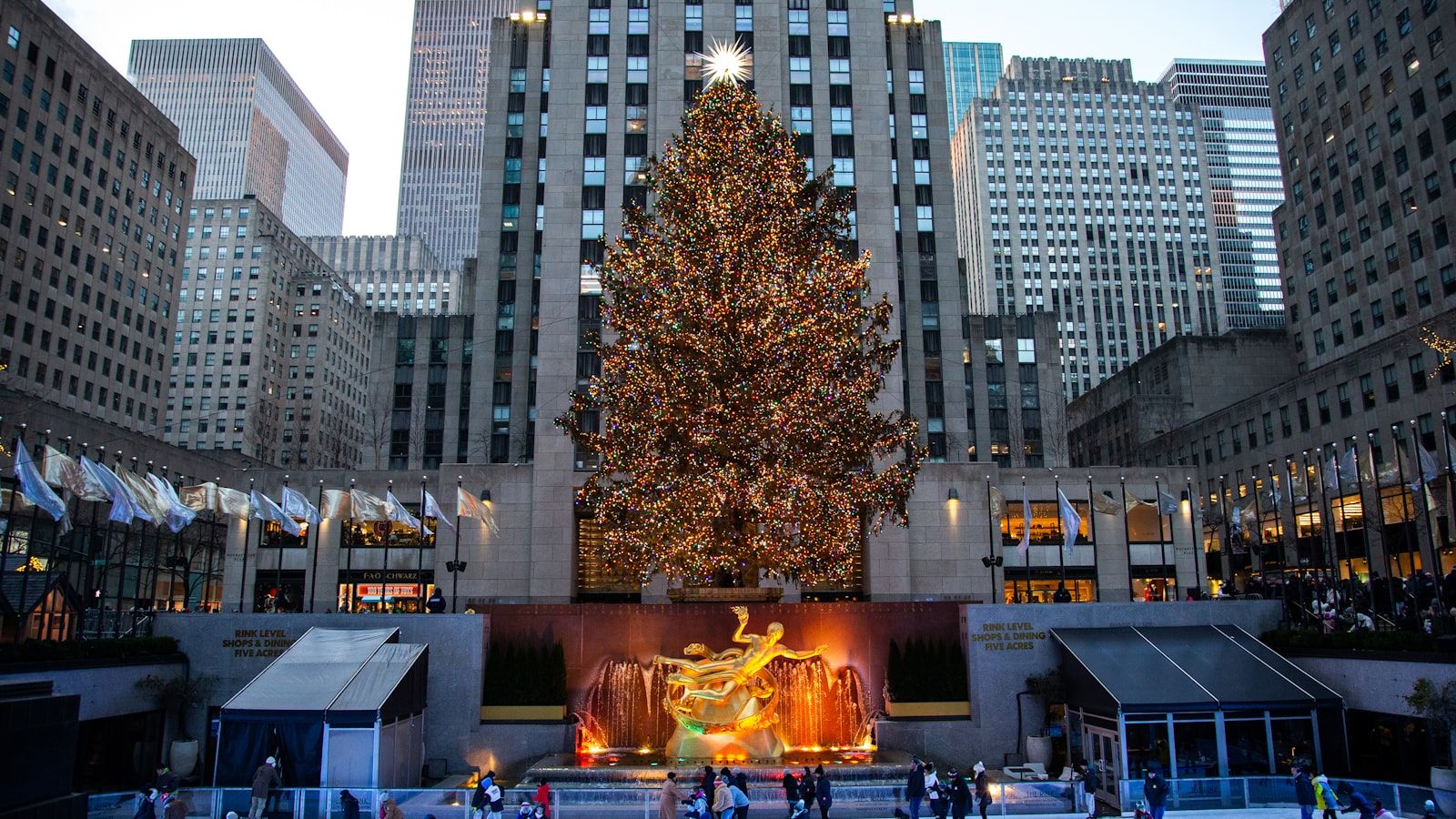
In the sunken plaza, the golden Prometheus watches over the Rink at Rockefeller Centre, which opened in 1936. He has been there through every winter since, looking down at skaters while Midtown rushes past above.
And just behind him, behind the golden plaza facade, Radio City Music Hall holds 6,000 seats inside one of the great Art Deco interiors America ever built. Most people walk past. Almost nobody goes in.
Rockefeller Centre was built in the darkest years this country has ever known. It was an act of stubbornness, of ambition, and — whatever you think of the man who paid for it — of genuine love for this city.
Walk through the Channel Gardens on a weekday morning, before the tourists arrive. Look up at the limestone towers. Think about what it took to build them.
New York has always done its best work when things looked most impossible.
What is the best time to visit Rockefeller Centre in New York?
Spring and fall offer the most comfortable weather for exploring the outdoor plazas and Channel Gardens. The skating rink runs from October through April, making winter a magical time to visit — though expect larger crowds from Thanksgiving through New Year’s.
Is Top of the Rock worth visiting compared to the Empire State Building?
Many visitors prefer Top of the Rock because you can see the Empire State Building in the skyline — something you cannot do from the Empire State Building’s own observation deck. Both offer 360-degree views, but Top of the Rock’s open-air sections give a cleaner, more dramatic perspective of Midtown.
Is Rockefeller Centre free to visit?
Walking through Rockefeller Centre’s plazas, Channel Gardens, and underground concourse costs nothing. Fees apply for Top of the Rock, the skating rink, Radio City Music Hall tours, and NBC Studio tours. You can easily spend a couple of hours here without paying a cent.
What neighborhoods are within walking distance of Rockefeller Centre?
Rockefeller Centre sits in the heart of Midtown Manhattan, within easy walking distance of Fifth Avenue shopping, the Theatre District, and Central Park (about 10 minutes north). Grand Central Terminal is about 10 minutes east on foot.
You Might Also Enjoy
- What Grand Central Terminal Is Really Hiding From Its 750,000 Daily Visitors
- What the Chrysler Building Hides That Most Visitors Never Think to Look For
- New York City Travel Budget: How Much Does a Trip to NYC Really Cost?
Plan Your New York Trip
New York City Travel Budget — A complete breakdown of what to budget for tickets, transport, food, and accommodation, including how to see the best of Midtown without overspending.
Join 1,100+ New York Lovers
Every weekday morning, get New York’s hidden gems, neighbourhood stories, food origins, and city secrets — straight to your inbox.
Subscribe free — enter your email:
📲 Know someone who’d love this? Share on WhatsApp →
Love more? Join 65,000 Ireland lovers → · Join 43,000 Scotland lovers →
Free forever · Unsubscribe anytime

Subscribe Free