
Little Italy sits in the heart of Lower Manhattan. For decades, it was the beating heart of Italian America. Today, it covers only a few blocks. But its story stretches across generations, oceans, and unimaginable sacrifice.
This is where Italian immigrants landed, survived, and built a new life. This is where they planted their culture in foreign soil. And this is where their descendants still return, looking for a trace of the world their grandparents left behind.
If you love New York’s hidden stories, you’ll love our free weekly newsletter. Subscribe to Love New York →
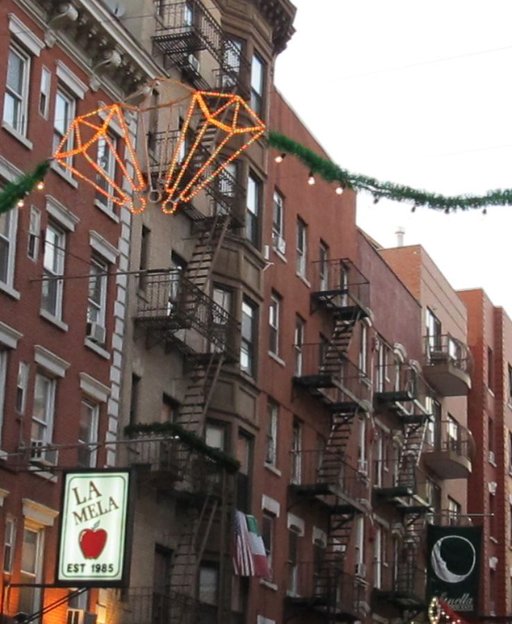
The First Arrivals
The first Italian immigrants to settle in Manhattan came in the 1880s. They were mostly from southern Italy — from Sicily, Calabria, Campania, and Basilicata. Life in southern Italy at that time was brutal. Poverty was widespread. Land was scarce. The government in Rome ignored the south.
These immigrants did not come to stay. Most planned to earn money and return home. They called themselves “birds of passage.” But New York had a way of keeping people.
They settled along Mulberry Street. They filled the streets around Hester, Grand, and Mott. The neighbourhood they created became known as Little Italy. It was not far from the area where Irish immigrants had settled generations earlier — the same Five Points neighbourhood that the Irish built in the 1820s and 1840s.
What Life Was Actually Like
The tenements were dark and crowded. A typical apartment on Mulberry Street held eight to twelve people. Families slept in shifts. Tuberculosis spread quickly in the airless rooms.
Men worked in construction, on the docks, or in garment factories. Women worked from home, sewing piecework for factories uptown. Children sold newspapers on corners. Everyone worked.
But they also celebrated. Feast days filled the streets with music and colour. The Feast of San Gennaro began in 1926. It is still held every September on Mulberry Street. It is one of the oldest Italian-American festivals in the United States.
Sunday supper was sacred. Neighbours gathered. The smell of tomato sauce drifted down the stairwells. For a few hours each week, the exhaustion of the week lifted. Food was never just sustenance — it was identity. The same immigrant spirit that gave New York its pastrami sandwich came from the same streets and the same hunger.
A Neighbourhood in Numbers
At its peak in the early 20th century, Little Italy was home to over 40,000 Italian immigrants. Mulberry Street was so densely Italian that some residents went years without learning English. Shops, churches, and newspapers all operated in Italian.
The community had its own hospitals, banks, and mutual aid societies. These were networks of trust in a city that often had none for immigrants. If you needed a loan, you went to a paesano. If you were sick, you went to the Italian hospital on Avenue A.
By 1940, the community had spread into Brooklyn, the Bronx, and Queens. The most successful families moved out. The neighbourhood began to shrink.
The Pushcart Markets
Hester Street was famous for its pushcart market. Vendors sold everything from salted cod to live chickens. The noise was extraordinary. Buyers and sellers argued in a dozen dialects.
The pushcart market was more than commerce. It was social glue. You met your neighbours there. You found out who had work. You heard news from home. For immigrants who felt invisible in the wider city, the market was a place of belonging.
A similar scene played out just blocks away on the Lower East Side, where Jewish immigrants from Eastern Europe built their own vibrant street market culture. The two communities lived in close proximity and shared many of the same struggles.
The city cleared most of the pushcart markets in the 1930s. A different New York was taking shape. But the memory of those streets stayed with the community for generations.
The Churches That Held the Community Together
The Church of the Most Precious Blood stands on Mulberry Street. It was built in 1891 by Italian immigrants. It is still open today. The church was not just a place of worship. It was a community centre, a welfare agency, and a place of identity.
The parish ran a school, a dispensary, and an employment bureau. Priests spoke Italian. The feast day celebrations were organised by the church. For immigrants who had left everything behind, the church was the one institution they could trust.
Old St Patrick’s Cathedral on Mulberry Street was another anchor. Built in 1815, it served Irish immigrants first. By the late 19th century, it was serving Italian immigrants too. It still holds services today. Its cemetery is one of the oldest in New York City.
How Little Italy Shrank
Little Italy did not disappear overnight. It shrank slowly, over decades. The reasons are complicated.
After the Second World War, many Italian-American families moved to the suburbs. They had prospered. They wanted gardens, cars, and distance from the old neighbourhood.
At the same time, Chinatown was growing. It expanded north along Canal Street and east along Mulberry. Block by block, the boundaries shifted.
Today, Little Italy officially covers just three blocks of Mulberry Street between Canal and Broome. The restaurants are still Italian. The feast day is still celebrated. But the community that built this neighbourhood has largely moved on.
Want more stories like this? Our weekly newsletter goes deeper into New York’s heritage every week. It’s free. Subscribe here →
What Survives Today
Mulberry Street is the heart of what remains. Walk it slowly and you will find things worth finding.
Alleva Dairy at 188 Grand Street has been open since 1892. It is the oldest Italian cheese shop in America. You can still buy fresh mozzarella and ricotta made on the premises. Bring a bag.
Di Palo’s Fine Foods, also on Grand Street, opened in 1903. Four generations of the Di Palo family have run it. They still import Italian cheeses and cured meats. The smell when you open the door is worth the trip alone.
Old St Patrick’s Cathedral offers heritage tours. The catacombs beneath the church hold the remains of early New York families. The garden outside is quiet and remarkable.
The Feast of San Gennaro takes over Mulberry Street every September. It lasts eleven days. There are zeppole, sausages, carnival games, and a procession carrying the statue of the patron saint of Naples. It is noisy, overcrowded, and wonderful.
Tracing Your Italian-American Roots in Little Italy
If your family came through Little Italy, there are ways to find them.
The Center for Migration Studies of New York holds immigration records and personal archives donated by Italian-American families. Its collection is invaluable for anyone researching Italian roots in the city.
The Italian Genealogical Group meets regularly and runs workshops on tracing Italian ancestry. They maintain a database of immigration and naturalisation records specific to the New York Italian community.
Ellis Island records are searchable online at the Statue of Liberty-Ellis Island Foundation website. Most Italian immigrants entered through Ellis Island between 1892 and 1957. A full manifest search can locate your ancestor’s ship, their hometown in Italy, and the name of the relative they were travelling to meet.
The Tenement Museum on the Lower East Side — a short walk from Little Italy — runs heritage walking tours. Some of the families documented there were Italian. Their stories are told with extraordinary care.
Frequently Asked Questions
How long has Little Italy been in Manhattan?
Italian immigrants began settling along Mulberry Street in the 1880s. By 1900, the neighbourhood was home to tens of thousands of southern Italian immigrants and has existed in some form for over 140 years.
How big is Little Italy today?
Today, Little Italy covers approximately three blocks of Mulberry Street between Canal Street and Broome Street. At its peak in the early 20th century, it covered a much larger area and housed over 40,000 residents.
What is the Feast of San Gennaro?
The Feast of San Gennaro is an annual Italian-American festival held every September in Little Italy. It began in 1926 and lasts eleven days, featuring food stalls, music, and a religious procession. It is one of the oldest Italian-American street festivals in the United States.
Where can visitors experience Little Italy’s heritage today?
Walk Mulberry Street and visit Alleva Dairy (est. 1892) and Di Palo’s Fine Foods (est. 1903). Old St Patrick’s Cathedral offers heritage tours, and the Tenement Museum nearby documents immigrant life in remarkable detail.
How do I trace my Italian-American ancestry in New York?
Start with Ellis Island passenger records at libertyellisfoundation.org. The Italian Genealogical Group and the Center for Migration Studies of New York both hold specialised resources for tracing Italian roots in the city.
Ready to explore the New York your ancestors knew? Subscribe to Love New York — free weekly stories, heritage guides, and hidden history. Join us →
You Might Also Love
