
In 1905, a Neapolitan baker unlocked the door to a narrow shop on Spring Street in lower Manhattan and changed what Americans eat forever. His name was Gennaro Lombardi. He had a coal-fired oven, a recipe nobody on this continent had tasted, and a neighbourhood full of immigrants hungry for something that felt like home.
The Immigrant Who Brought the First Pie to America
Lombardi arrived in New York in 1897 from Naples, where pizza had been a street food for centuries — cheap, satisfying, eaten standing up. In New York, he started with a grocery on Spring Street in Little Italy, wrapping pies in paper and tying them with string. No tables. No menu. Just pizza, sold by the pie.
By 1905, Lombardi’s was officially licensed — the first pizzeria in America. The neighbourhood smelled like something completely new. Dock workers lined up. Other Italian immigrants crowded the counter. Word moved fast through the tenements.
Lombardi’s still operates a few blocks from its original address today. If you go, order what the neighbourhood ordered in 1905: the margherita, with fresh mozzarella, crushed tomatoes, and basil. It hasn’t changed much. It doesn’t need to.
The Italian immigrant community that built this food culture shaped an entire neighbourhood around it. The story of Little Italy — how it grew, shrank, and survived across a century — explains everything about why that original block still matters.
Why New Yorkers Are Serious About the Water
Ask any New York baker what makes the dough different and they’ll give you the same answer without hesitation: the water. Visitors find this amusing. New Yorkers don’t blink.
New York City’s tap water is exceptionally soft — low in calcium and magnesium compared to most American cities. That mineral content affects how gluten forms in dough, how it stretches, and how it crisps at high heat. Change the water and you change the dough. It’s chemistry, not mythology.
Bakers in other cities have actually shipped in New York tap water to test the difference. Several noticed a genuine change. Whether the water is everything or just one variable among many, the result is consistent: a New York slice tastes like a New York slice. Nobody has fully replicated it anywhere else on Earth.
Coal Ovens and the Char That Changed Everything
Lombardi’s original oven burned coal. So did the one Totonno’s lit in Coney Island in 1924, opened by Antonio Totonno Pero — also from the same coastal region of Naples as Lombardi.
Coal burns hotter and more evenly than gas. Those original ovens reached 900°F or above. At that temperature, dough scorches on the bottom in under three minutes. The result is a thin layer of char — small black spots that aren’t burnt, but caramelized. That slight bitterness is part of the flavor. You’re supposed to taste it.
When New York banned coal-fired ovens in the 1970s for environmental reasons, most pizzerias switched to gas. A few fought for exemptions. Patsy’s in Harlem — open since 1933 — still runs the same coal-fired ovens it has operated for nearly a century. The char is indistinguishable from the original.
Enjoying this? Join New York lovers getting stories like this every week. Subscribe free →
The Fold: New York’s Most Copied Habit
In the 1960s, New York slice shops began selling pizza by the individual piece. It transformed how the city ate — and created one of the most distinctive gestures in American food culture.
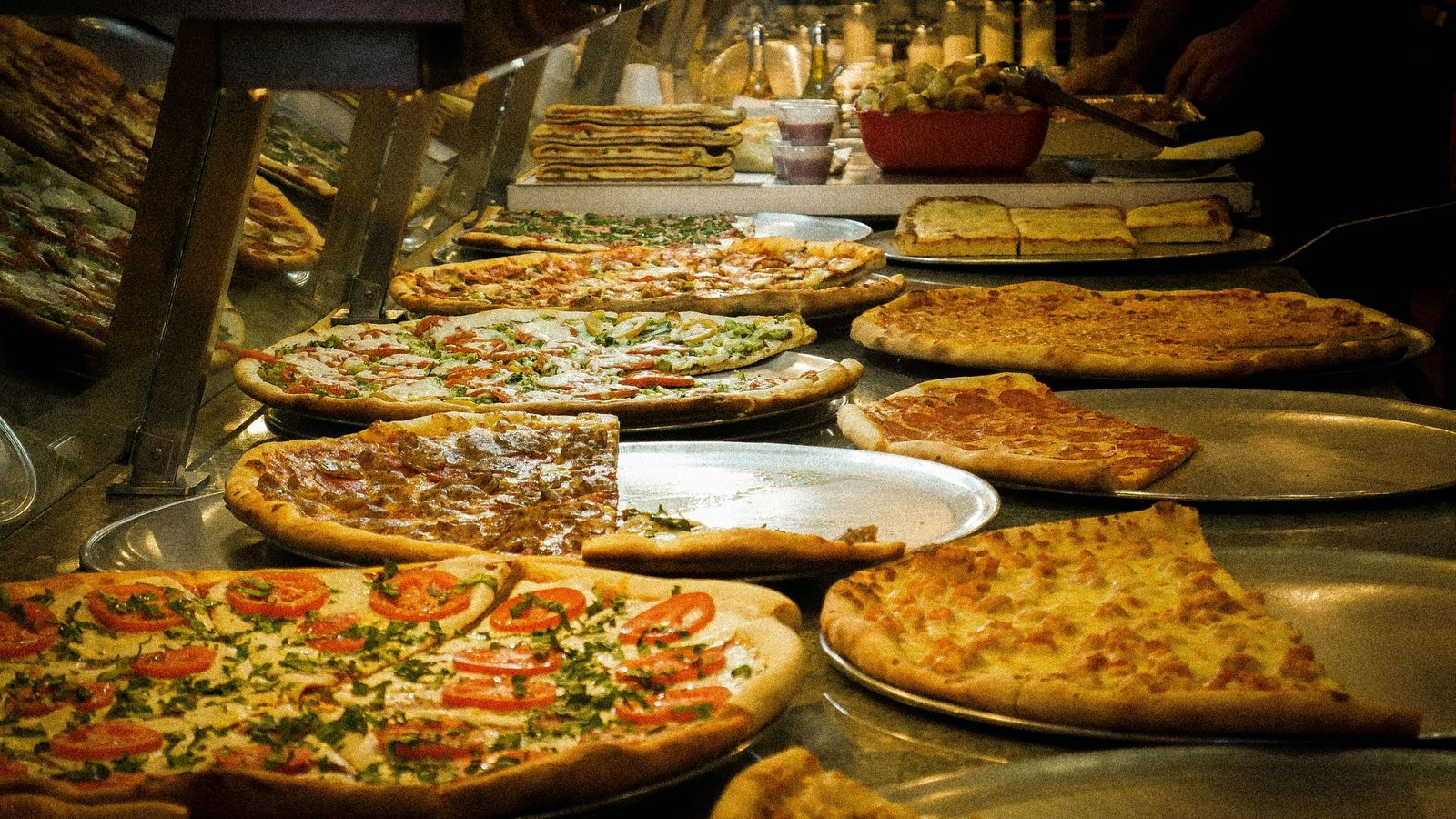
A New York slice is wide, thin, and floppy. Held flat, it droops. New Yorkers solved this the way they solve most things: practically. You fold it in half lengthwise, crease it down the centre, and eat while walking. No plate. No fork. One hand free.
In Naples, pizza is eaten sitting down, flat, with cutlery. In Rome, it’s sold by weight and cut with scissors. Only in New York did a city’s pace of life create its own eating posture. The fold isn’t a quirk. It’s an adaptation — pizza evolving to match a city that never actually stops moving.
Di Fara and the Case for Obsession
For nearly sixty years, Domenico DeMarco made every pizza himself at Di Fara Pizza in Midwood, Brooklyn. He arrived from Italy in 1959 and opened the shop in 1965. Until his death in 2022, he cut his own basil fresh for every pie, imported his flour from Italy, and used no shortcuts. None.
Lines at Di Fara stretched around the block for decades. Food critics called it the finest pizza in New York. DeMarco shrugged at all of it and kept making pies. That refusal to scale, to automate, to compromise — that was the point.
What Di Fara represented is still the animating idea behind the best pizza in this city: it’s not a product. It’s a practice. Repeated thousands of times, refined across decades, until something unrepeatable emerges. The same idea Gennaro Lombardi brought to Spring Street in 1905.
New York’s food identity runs deep in these traditions. If you love tracing where iconic flavors came from, the story of the New York bagel follows a remarkably similar arc — immigrant craft, local water, and a city that adopted someone else’s food and made it completely its own.
The Argument That Never Ends
Ask ten New Yorkers to name the best slice in the city and you’ll get twelve answers. This is not a flaw in New York pizza culture. It is the entire point of it.
The city has roughly 1,700 active pizzerias. Each neighbourhood defends its own. Classic coal-fired houses like Patsy’s and Totonno’s hold one kind of reverence. Midwood mourns Di Fara. New Williamsburg newcomers push Neapolitan-style wood-fired pies with buffalo mozzarella and fermented dough.
The one point of agreement: the slice. The $3 triangle of dough, sauce, and mozzarella eaten on the sidewalk at noon on a Tuesday. That’s New York pizza. That’s what Gennaro Lombardi set in motion on Spring Street, and it shows no signs of stopping.
Frequently Asked Questions About New York Pizza
Where was New York pizza invented?
New York’s first pizzeria was opened by Gennaro Lombardi on Spring Street in Little Italy, Manhattan, in 1905. Lombardi was a Neapolitan immigrant who brought the recipe from southern Italy and adapted it for American ovens and ingredients.
What makes New York pizza different from pizza everywhere else?
New York pizza is defined by large, thin, foldable slices with a charred base from high-heat ovens. Many bakers also credit New York City’s naturally soft tap water — low in minerals — with giving the dough its distinctive texture and stretch. No other city has been able to fully replicate it.
Where can you find the best classic New York pizza?
For historic authenticity, Lombardi’s on Spring Street and Totonno’s in Coney Island are both over a century old. Patsy’s in Harlem has been running since 1933. Di Fara in Midwood, Brooklyn, became legendary under Dom DeMarco’s lifetime of craft. Any neighbourhood counter-service slice shop with a line out the door is also a reliable starting point.
What is the best time of year to try New York pizza?
New York pizza is available year-round, but locals often say late summer and fall are the best times to eat a slice standing outside — warm evenings, longer days, and the natural rhythm of the city at its best. For full guidance on planning your visit, see our month-by-month guide to New York.
You Might Also Enjoy
- The Little Italy That Italian Immigrants Built — A Story of Survival and Pride in Manhattan
- Why New York Bagels Taste Different From Every Other Bagel in the World
- New York City Food Guide: What to Eat, Where to Go, and How to Do It Right
Plan Your New York Trip
Ready to taste the real thing? Our month-by-month guide to New York City covers the best times to visit, what to expect in every season, and how to plan a trip that goes beyond the tourist trail.
Join 1,100+ New York Lovers
Every weekday morning, get New York’s hidden gems, neighbourhood stories, food origins, and city secrets — straight to your inbox.
Subscribe free — enter your email:
📲 Know someone who’d love this? Share on WhatsApp →
Love more? Join 65,000 Ireland lovers → · Join 43,000 Scotland lovers →
Free forever · Unsubscribe anytime

Subscribe Free