
In 1903, police officers walked a particular beat on 23rd Street that had nothing to do with crime. Every day, groups of men stationed themselves at the corner of Fifth Avenue and Broadway. They weren’t waiting for a streetcar. They weren’t pickpockets or protesters.
They were waiting for the wind.
The Building That Made New York Believe Anything Was Possible
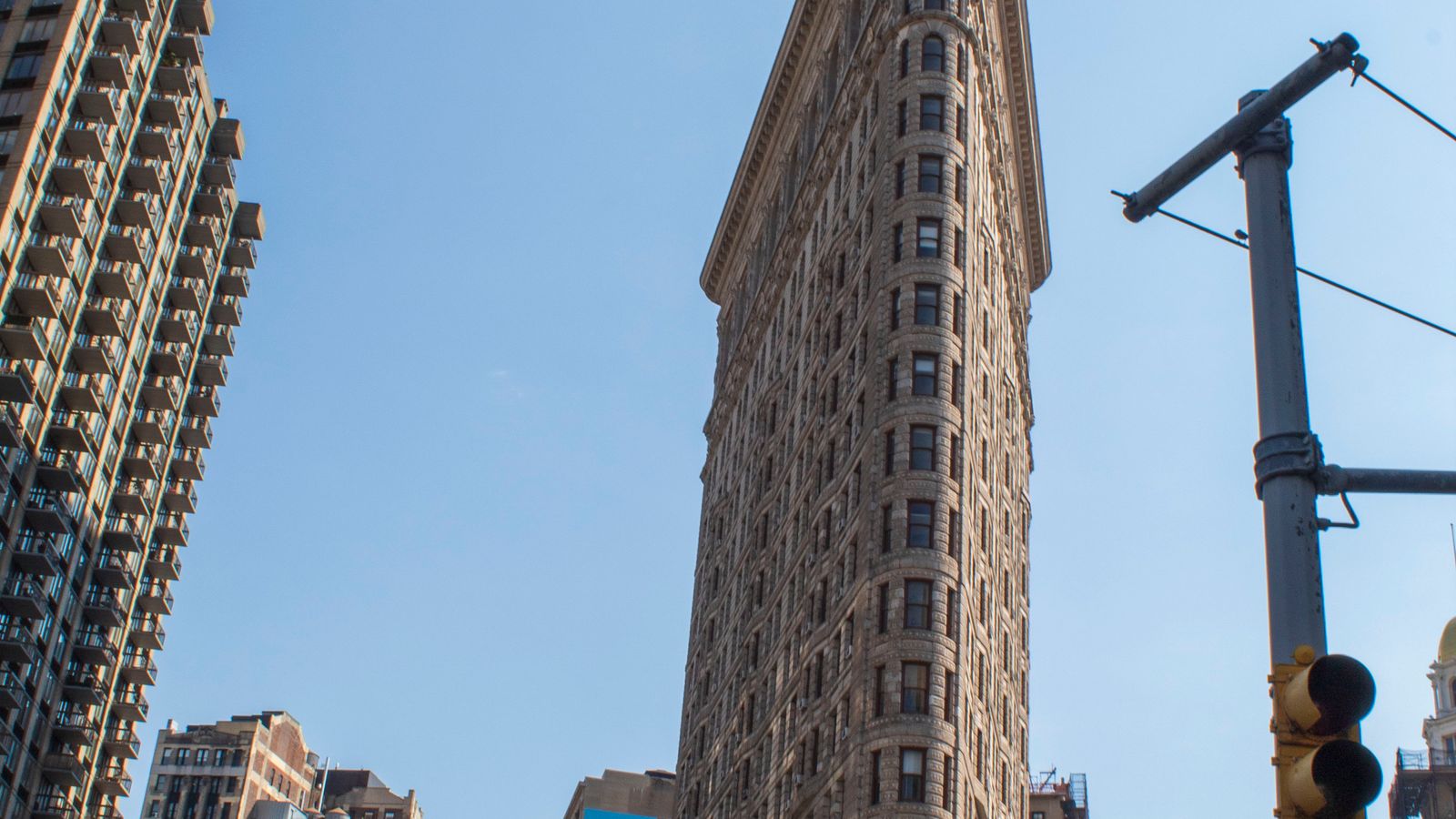
When architect Daniel Burnham accepted the commission for the Fuller Building in 1901, he was handed a problem that most architects would have refused. The lot was a narrow triangular wedge — a leftover slice of land where Fifth Avenue and Broadway crossed at 23rd Street.
Burnham looked at it and designed a skyscraper.
The result was 22 stories of limestone and glazed terracotta, rising 285 feet above one of Manhattan’s busiest intersections. The building’s northern tip came to a point just six feet wide — the blunt prow of a stone ship cutting through the city grid.
New Yorkers named it after the cast-iron pressing tool it resembled. The Flatiron Building. The name stuck so completely that the entire neighborhood eventually took it too.
The Wind Problem Nobody Predicted
Here is what Burnham hadn’t fully calculated: the building’s shape would funnel wind with startling force.
Fifth Avenue and Broadway ran alongside the building like two long wind channels. When gusts came from the north, they hit the prow and split. Each current picked up speed as it squeezed down the flanking corridors and hit the street at the base.
At the corner of 23rd Street, the updrafts became fierce. Hats flew off. Umbrellas inverted. Newspapers skidded across the pavement.
And women’s skirts — long and full by the standards of the day — billowed upward in ways that turned heads across the block. Every day. Reliably. Predictably.
The crowds followed.
“Twenty-Three, Skidoo!” — The Day New York Invented a Phrase
The men who gathered at that corner weren’t subtle about what they’d come to see. Groups assembled daily, waiting for the wind to cooperate. The scene was regular enough — and disruptive enough — that the city dispatched police to manage it.
Officers repeated one instruction, over and over: Get out of here. Twenty-three, skidoo.
The phrase caught on. It spread through the city, then through vaudeville acts and newspaper columns, and eventually across the country. “Twenty-three skidoo” — meaning get lost, clear off, move along — is widely considered one of the first slang phrases to travel nationally in the United States.
The Flatiron Building hadn’t just changed the skyline. It had changed the language.
Enjoying this? Join New York lovers getting stories like this every week. Subscribe free →
The Photographers Who Saw Something Else Entirely
While men gathered at the base for entertainment, New York’s serious artists recognized something genuinely new in this strange building.
Alfred Stieglitz photographed it in winter — snow falling, the building rising through bare trees in Madison Square Park like a ghost ship emerging from fog. He called it “the new America still in the making.” The image became one of the most reproduced photographs of early twentieth-century New York.
Edward Steichen returned again and again. At twilight. In rain. At different seasons. The building’s two long faces catch the light differently depending on the time of day. The prow glows pale gold at noon, bruises blue at dusk, and turns silver-gray in overcast weather. Steichen couldn’t leave it alone.
These weren’t photographs of a building. They were attempts to capture what it felt like when New York was becoming something the world had never seen before — and hadn’t yet found a way to describe.
You can still see Stieglitz’s Flatiron shots at the Metropolitan Museum of Art. The building in the image looks exactly like the building on the street today. That almost never happens in this city.
What the Flatiron Is Now
The Flatiron Building spent most of its life as an office building. After sitting empty for years following the departure of its last major tenants, it sold at auction in 2023 for $190 million to a group planning to convert it into residential apartments.
Construction is underway. Scaffolding wraps the building. The famous prow is hidden behind protective netting. Workers are busy transforming 22 floors of office space into something new.
But stand at the corner of 23rd and Fifth on a blustery afternoon and you’ll still feel it — that particular gust, still funneling down from the north, still splitting at the tip, still swirling at the base. The building’s geometry hasn’t changed. Neither has the wind.
The police are long gone. The crowds have moved on. The phrase they inspired has mostly faded from daily use. But the Flatiron remains exactly where it has always been, pointed north, stubborn and impossible and unmistakably New York.
New York has always been a city that makes the impossible look inevitable. A triangle on a triangular lot. A prow cutting through a grid. A building so strange it created a wind hazard, a new slang phrase, and one of the most photographed corners in the world — and then outlasted all of them.
When you round the corner and see that pointed face rising ahead of you, take a second to stand at the very tip. Feel the wind split around you. That’s 120 years of New York history pressing against your coat.
You Might Also Enjoy
- The Chrysler Building Was Built Around a Secret That Nobody Knew Until It Was Too Late
- Hidden Gems in NYC: The New York Most Tourists Never See
- The Wild Heart of Central Park Most New Yorkers Have Never Explored
Plan Your New York Trip
Heading to the city and want to make the most of your time? Our New York in 3 Days itinerary takes you through the neighborhoods and landmarks that make New York unlike anywhere else on earth.
Join New York Lovers
Every weekday morning, get New York’s hidden gems, neighbourhood stories, food origins, and city secrets — straight to your inbox.
Subscribe free — enter your email:
Love more? Join 65,000 Ireland lovers → · Join 43,000 Scotland lovers →
Free forever · Unsubscribe anytime
